
The Principal's Perspective
When people ask me what Education 2.0 looks like, they almost always expect me to talk about technology: artificial intelligence, personalized learning, dashboards and data. I almost never begin there. Instead, I tell them about a Friday afternoon in Tokyo.
Friday Afternoons
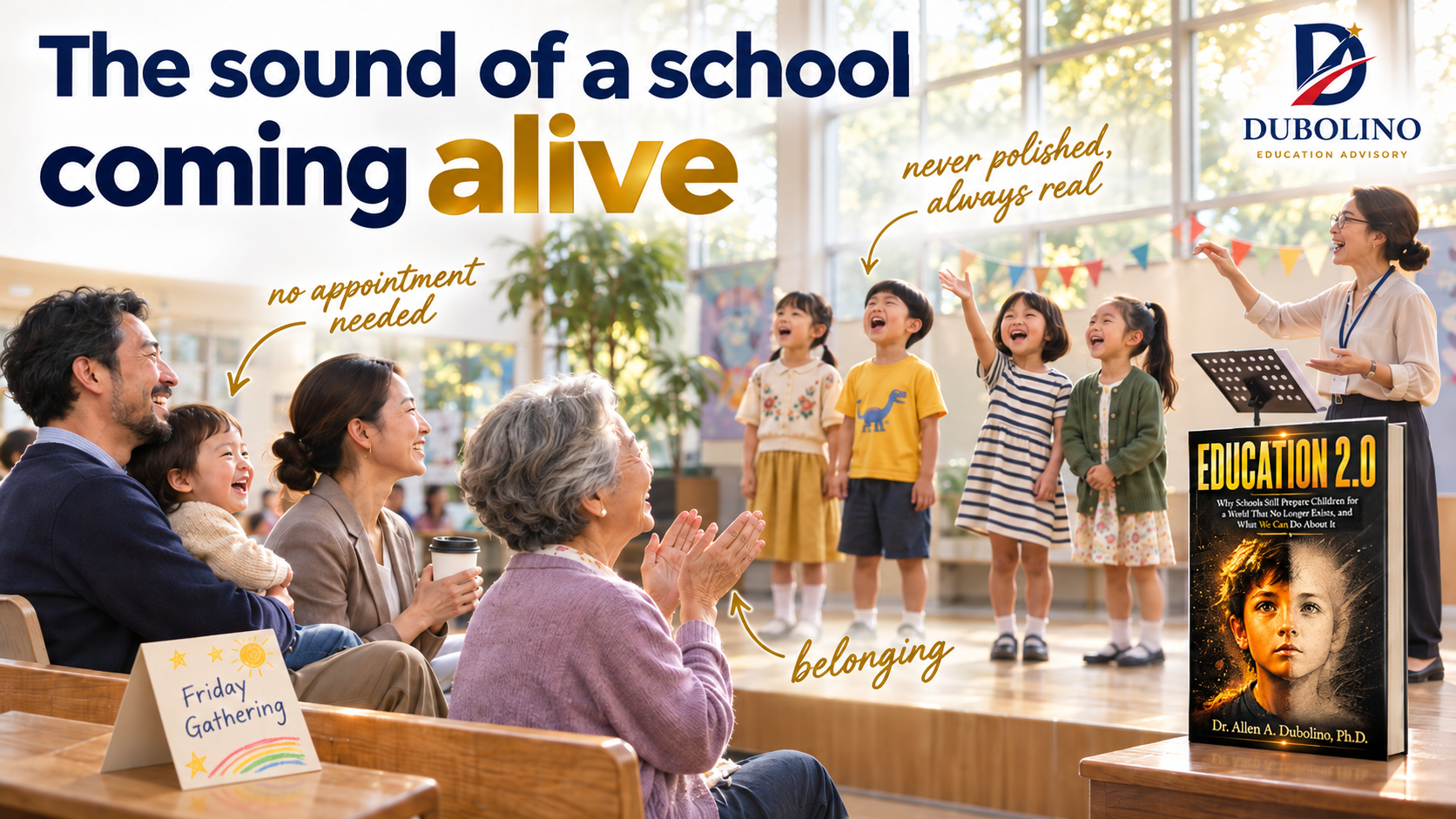
Every Friday after lunch, the front doors of our school stayed open. Parents wandered in carrying coffee, some still dressed for work, some pushing a younger sibling in a stroller. Sometimes a grandparent came instead. And nobody walked in with the tight, nervous look of a parent who has been called in because something went wrong. Friday afternoons belonged to everyone.
The children sang, danced, or showed something they had learned that week. The performances were never polished, and that was the beauty of them. Sometimes a child forgot the words. Sometimes another spent the whole song waving at their parents instead of watching the teacher. The parents were not there to evaluate anyone. They were there to celebrate.
Then came the part that mattered most: nobody hurried home. Parents stayed, teachers stayed, children kept playing, and the kind of conversation began that never happens in a fifteen-minute conference. A father mentioned that his daughter had suddenly fallen in love with reading, and the teacher explained what had finally unlocked it. A mother admitted that bedtime had become a nightly battle, and three other parents leaned in, because they were fighting the same battle. No appointment necessary. No crisis required.
Where the Idea Came From
I did not invent this from theory. I stumbled into it years earlier, as principal of a boarding school in southern Thailand, where parents were often hundreds or thousands of kilometers away. Everyone cared deeply, and yet something was missing. It was family.
We invited parents on holiday
Instead of another formal meeting, several times a year we rented an entire resort and everyone came: teachers, students and parents. No report cards, no presentations. Teachers lost spectacularly at volleyball, parents cooked side by side, and conversations around the campfire drifted from schoolwork to life. It is hard to remain strangers after losing a water balloon fight together.
We built it into the ordinary year
When we founded a school in Tokyo, I wanted the same feeling without asking families to give up their weekends. So it became part of the normal rhythm: the Friday gatherings, an annual family picnic, a community evening. Songs, games, shared meals. Nothing revolutionary, and yet it changed everything.
One year, at our family picnic in Yoyogi Park, I looked across the field and realized I could no longer tell at a glance who was a teacher, who was a parent and who was school leadership. A father was helping another family's child through an obstacle course. Teachers were laughing with parents on picnic blankets. Someone had burned the sausages, and nobody cared. We had quietly stopped behaving like a school. We had become a village.
"Children do not remember optimized childhoods. They remember belonging."
Why This Is Not a Nice Extra
Education has become quietly obsessed with efficiency: the shortest meeting, the quickest assessment, the fastest dismissal. But the moments children carry with them are the teacher who laughed with them, the picnic, the afternoon their father finally met the teacher whose name he had been hearing at dinner every night.
These moments also do real work. In my last article I wrote about trust between home and school as an account built up long before it is needed. Fridays, picnics and shared meals are what those deposits actually look like. When the hard day comes, and it always does, the schools that made them discover that trust is already there.
- Laughter drifting out of the classrooms.
- Teachers asking one another for help without fear.
- Parents lingering after dismissal because nobody quite wants to leave.
- Children who feel completely safe being exactly who they are.
- And ask: when do parents come to this school when nothing is wrong?
Years after I left Tokyo, a mother whose children had long since moved on sent me an email. She was not writing about grades or reading scores. She wrote one line I have never forgotten: "Our family still talks about Fridays."
Children deserve excellent schools. Families deserve beautiful memories. The best schools refuse to choose, and give children both.
Education 2.0
Read the full chapter on the sound of a school becoming alive.
Education 2.0 lays out the six systems behind a school designed around your child, and why the community around a child matters as much as anything that happens in the classroom.
Dr. Allen A. Dubolino, Ph.D. is the founding Head of School at New American Chinese International School (Nonthaburi, Thailand) and Head of School at Four Leaves International School Tokyo. He has 22 years of international school leadership experience across Japan and Thailand and is the founder of Dubolino Education Advisory.
