
The Museum of Unfinished Masterpieces.
The Principal's Perspective
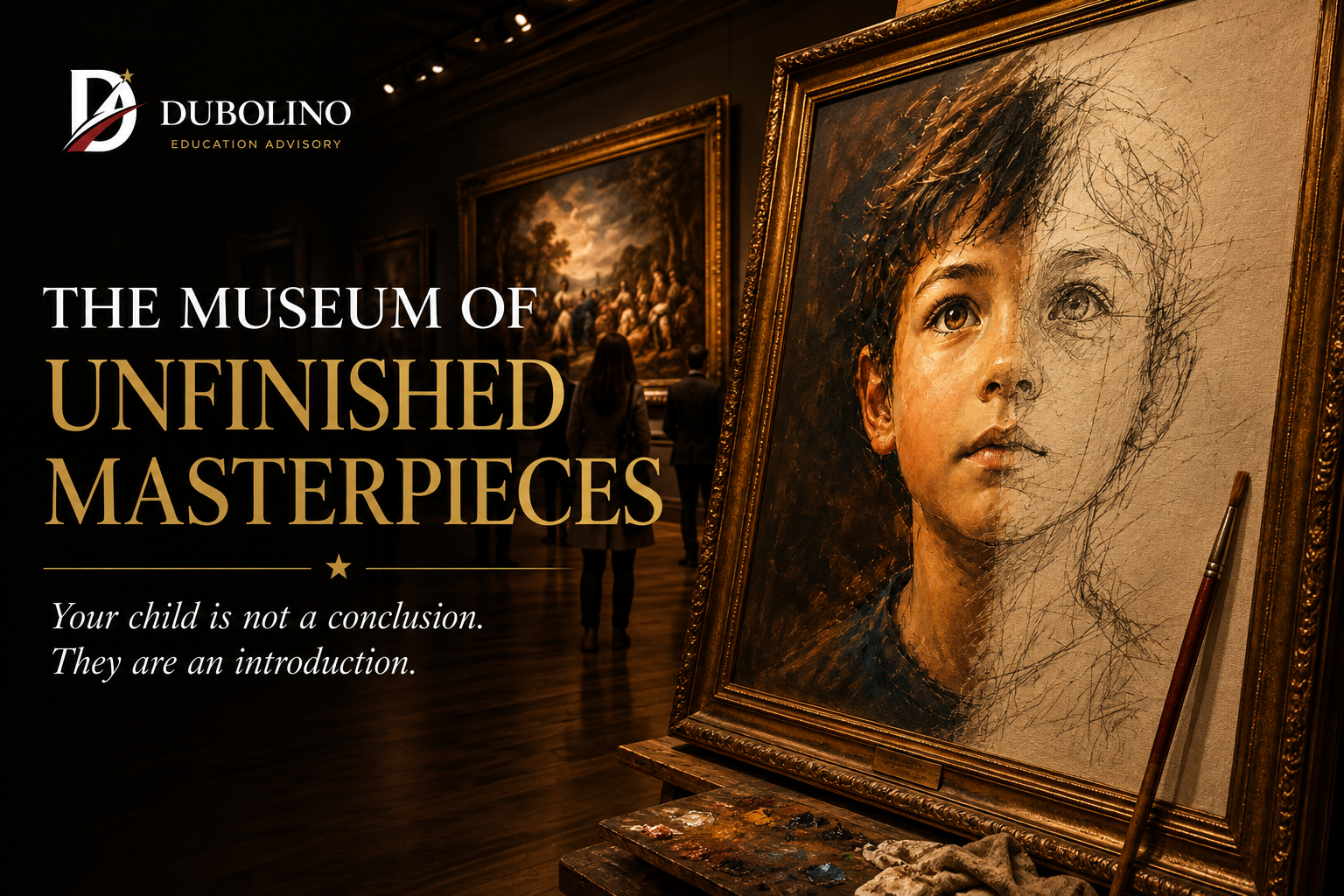
The Museum of Unfinished Masterpieces Your child is not a conclusion. They are an introduction.
A gallery of half-painted canvases taught me the most important thing I know about children, and about how early we decide who they are going to be.
A few years ago I found myself wandering through an art museum. I should confess that I have never been particularly knowledgeable about art. I could not tell you the difference between Impressionism and Expressionism without embarrassing myself, and my friends will happily tell you that I spend more time reading the little information cards on the wall than looking at the paintings themselves. But something happened that afternoon that has stayed with me ever since, and it has almost nothing to do with art.
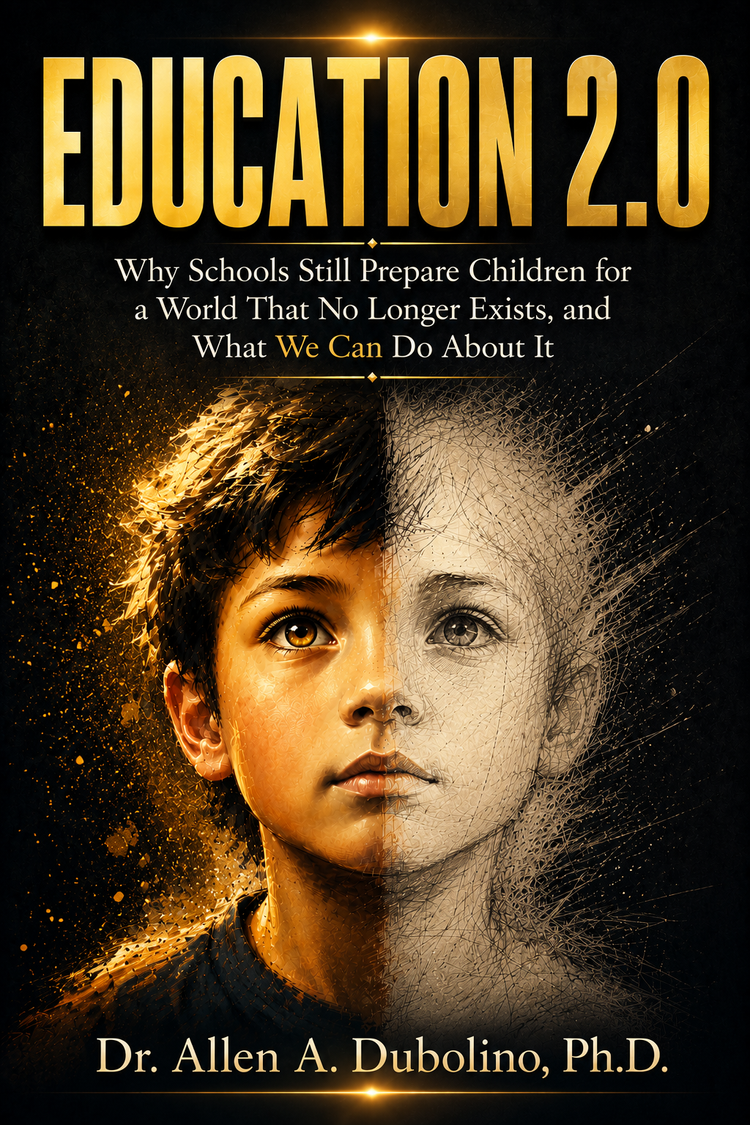
In one gallery hung dozens of unfinished paintings. Not damaged, not abandoned, simply unfinished. Some had only rough pencil outlines. Some had a beautiful face just beginning to emerge from a blank canvas. Some were little more than a few confident brushstrokes suggesting what might one day have become a whole world.
And here is what I noticed. People walked past them almost without slowing down. Everyone hurried toward the completed masterpieces in the next room. The finished paintings had crowds around them. The unfinished ones had empty space.
I stood there longer than I probably should have, thinking a strange thought. If Michelangelo had died halfway through painting the Sistine Chapel, would people look up at that ceiling and conclude he had lacked talent? Or would they simply understand that they had arrived too early?
And it struck me, standing in that quiet gallery, that children live in a world where people arrive too early all the time.
Arriving too early
We meet a six-year-old and quietly decide she is not mathematical. We meet a ten-year-old and conclude he is not creative. We meet a fifteen-year-old who cannot sit still and begin talking about him as though we have already seen the finished painting, as though the rough pencil lines in front of us were the whole of what he would ever be.
Imagine how absurd that habit would sound anywhere else in life. No gardener walks into an orchard in early spring, points at a tree that is not yet bearing fruit, and says, well, I suppose this one will never amount to anything. Of course not. The gardener understands something obvious that schools have somehow forgotten. The season is simply wrong. There is nothing failing about the tree.
Children are seasonal in exactly the same way. Some bloom in spring, early and visibly, the ones who read at four and dazzle everyone at the school assembly. Some bloom in autumn, late and quietly, long after the world has stopped watching for it. And some spend years building roots underground, where no one can see the work happening, before anything at all appears above the surface.
Schools, however, are remarkably impatient places. We measure children every few months. We rank them, sort them, and label them, as though human development ran on quarterly reporting cycles, as though a person could be behind schedule on becoming themselves.
We laugh at this, because everyone knows a caterpillar is not a failed butterfly. It is a butterfly that has not happened yet. And then on Monday morning we walk back into school and do something remarkably close to it, with a straight face, to children.
The privilege of watching time prove you wrong
I once knew a boy who could not spell. Every spelling test he took looked like a battlefield, red ink everywhere, teachers sighing before they even handed the paper back. If you had met him then, you might have quietly concluded that he simply was not academic, that this was not a child with much of a future in learning. Twenty years later, he owned three companies. Meanwhile, across those same years, I have met straight-A students who were quietly terrified of making a single decision without permission. Life has a peculiar habit of refusing to honor our early predictions.
One of the great privileges of spending twenty-two years in education is that you eventually get to cheat. A teacher usually sees a child for one year. A principal might see them for three or four. But if you stay in this work long enough, something remarkable happens. You meet them again. At twenty-five, at thirty, at thirty-five. The shy child who never raised her hand becomes the one leading the room. The class clown becomes a surgeon. The straight-A student burns out, and the quiet one in the back who barely spoke now leads a team of hundreds.
Stay in education long enough and it hands you an extraordinary gift. You get to watch time prove everybody wrong. Including yourself. Especially yourself.
I remember one of the funniest moments of my career, which happened in an ordinary parent meeting. A father leaned across the table and told me, with complete sincerity, that his son was allergic to homework. I looked over at the boy, who looked back at me with the expression of someone whose secret medical condition had finally, tragically, been discovered. Remarkable, I told the father. I have met hundreds of children with exactly the same rare illness. Even the boy laughed, and something in the room loosened, because humor has a wonderful way of reminding everyone that we are on the same team. That father was not raising a lazy child. He was raising a child. Those are very different things, and it is astonishing how often we confuse them.
The question that freezes, and the question that frees
I sometimes wonder what would happen if schools stopped asking what is this child, and started asking what might this child become. They sound similar. They are profoundly different questions, and they lead to profoundly different places.
What is this child?
Pins a child to the wall like a specimen and reads their whole future off a single moment. It is a verdict.
What might this child become?
Hands them a future that is still open, and hands the adults in the room a job worth doing. It is an invitation.
Years ago a teacher came to me and apologized, actually apologized, because one of her students was, in her words, just average. I asked her a single question in return. Average compared to whom? Compared to the tallest child in the class? The fastest? The loudest? The earliest reader? The one whose parents had hired three tutors?
There has never once, in the history of the world, been an average child. There have only ever been averages, invented by comparing incomparable people and then pretending the number means something about any one of them.
I want to be careful here, because that teacher was not the problem. She had been handed a system that asks her to sort children into bands and report the sorting every few weeks, and she was doing her job faithfully inside it. The teachers I have worked with across twenty-two years are, almost without exception, extraordinary people being asked to run an obsolete machine. The machine is what deserves our anger. They deserve our defense.
Potential rarely introduces itself politely
The older I get, the less interested I am in identifying gifted children, and the more interested I am in identifying unseen ones. Giftedness is usually loud. It announces itself, wins the prize, sits at the front. Potential, on the other hand, usually whispers. Sometimes it whispers through poor grades. Sometimes through a child who will not stop asking questions. Sometimes through boredom, or stubbornness, or a silence no one has bothered to look behind. One of the greatest mistakes schools make is assuming that potential will always introduce itself politely. It almost never does.
When I think about the very first child whose story opens my book, a boy who cried in a hallway because someone finally seemed to care whether he passed, I notice something. I no longer remember the spelling test that set it off. I do not remember his grade. I could not tell you how many words he got right or wrong that day. What I remember is a boy crying because someone cared. That is the memory that survived. Not the assessment. The relationship. Funny, is it not, that schools spend such extraordinary energy preserving grades, while life seems quietly determined to preserve moments instead.
If someone asked me today what the single greatest lesson of twenty-two years in education has been, I do not think I would talk about curriculum, or assessment, or artificial intelligence. I think I would just say this. Never confuse the chapter you are reading with the whole book.
Perhaps that is the real reason I believe education must change, and I want to be clear that it is not because I have lost faith in children. It is precisely the opposite. I have spent my life watching children become things no report card ever predicted. I have watched so-called average children become exceptional human beings. I have watched broken confidence quietly heal because one teacher refused to stop believing in a child everyone else had filed away. I have seen it happen often enough that I no longer think of those moments as miracles. I think they are simply what happens whenever one human being decides to truly see another.
Maybe that is the real purpose of education. Not to decide which children have the brightest futures, but to make sure no child's future is decided too early. Because every child arrives in our care like one of those unfinished paintings on the museum wall, a few rough lines, a face just beginning to emerge, a world only suggested.
It takes a strange kind of arrogance to look at an unfinished masterpiece and mistake it for a finished failure. It takes a rarer kind of hope to look at those first uncertain pencil lines and say, quietly, I think I know what this might become.
Every child deserves at least one adult willing to say those words. Tonight, that adult can be you. Not with a strategy or a program, just with a sentence at the dinner table that treats your child as an introduction rather than a conclusion. And then the harder question, the one this book spends the rest of its pages answering. What would a school look like if it were designed, from the ground up, to say those words too.
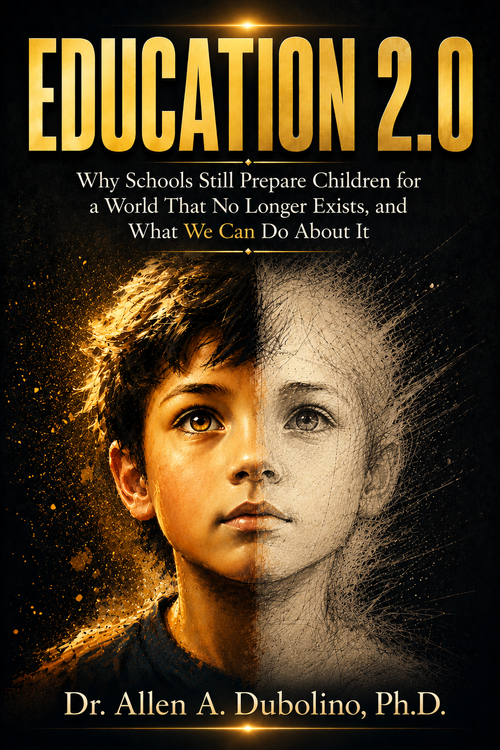
This was one chapter. There are twenty-two more.
Education 2.0 is the full argument: why the classroom your child sits in has not changed in a century, what the next century will actually ask of them, and what a school built for that world looks like in practice. Written for parents first, with nothing to sell you along the way.
Buy on AmazonDr. Allen A. Dubolino, Ph.D. is the founding Head of School at New American Chinese International School in Nonthaburi, Thailand, and co-founder of Four Leaves International School Tokyo. He has 22 years of international school leadership experience across Japan and Thailand and is the founder of Dubolino Education Advisory.
