
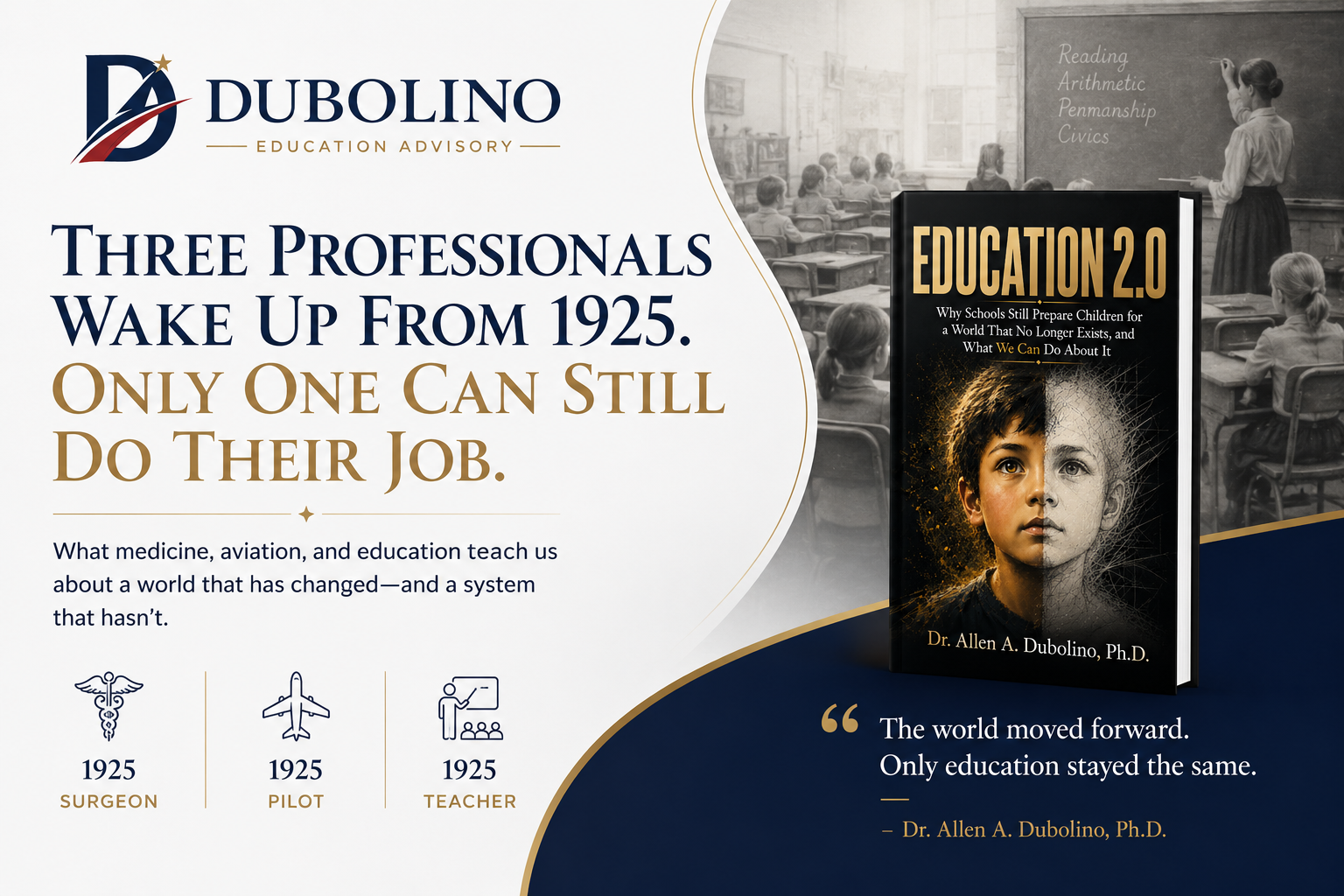
Three Professionals Wake Up from 1925. Only One Can Still Do Their Job…
The Principal's Perspective
Three Professionals Wake Up
From 1925.
Only One Can Still Do the Job.
A surgeon, a pilot, and a teacher — trained a century apart from the world they'd wake up in. Two of them we'd never let near the work again.
Try a small experiment with me. Imagine three professionals from 1925 fall asleep tonight and wake up in our world tomorrow morning. A surgeon. A pilot. A teacher. Each one was the best at their craft in their own time. We send all three back to work.
The surgeon walks into a modern operating room and is lost within a minute. She doesn't recognize the monitors, the imaging, the anesthesia, the instruments — not even the language the team around her is speaking. If she so much as reaches for a patient, someone stops her, because a century of progress stands between what she knows and what the job now requires.
The pilot walks out to the aircraft and the result is the same. He looks for a propeller that isn't there. The cockpit is a wall of glass and computation that bears no resemblance to anything he ever flew. He can't file the flight plan, can't talk to the tower, can't read a single instrument.
Now send in the teacher. She walks into a classroom. Desks in rows. A board at the front. Children waiting, facing forward. She picks up the chalk — or the marker — and starts the lesson. And it works. The students follow. The structure holds. Most people watching wouldn't notice anything strange at all.
The Surgeon
Cannot FunctionThe Pilot
Cannot FunctionThe Teacher
Still Works TodayTwo of those three people are now a danger to anyone who lets them work. The third can step straight back into her role as if no time had passed at all.
We tell that story as if it were charming. A nice bit of continuity. Look how timeless good teaching is. It isn't charming. It's the most disturbing fact about your child's education, and once you've seen it, you can't unsee it.
The Century That Changed Everything Except This
Think about what actually happened between 1925 and now. Medicine was reinvented — more than once. Communication was reinvented. The way we work, shop, travel, and find information was torn down and rebuilt so many times that a person from 1925 dropped into an ordinary Tuesday today would understand almost nothing of what they saw.
And then they'd walk into a classroom and feel, for the first time all day, completely at home. The single institution we trust with the formation of our children — the one place whose entire purpose is to prepare them for a future — is the one place that has most stubbornly resisted being touched by it.
This Isn't Nostalgia. It's Malpractice.
I know that's a hard word, so let me be precise about what I mean by it. The unchanged classroom feels comforting because it flatters a story we want to believe: that some things are eternal, that good teaching is good teaching in any era. There's a sliver of truth in that. The industrial classroom wasn't built by fools. For its time, it did a job worth doing.
But that job is gone. The classroom was built to prepare children for a world of factories, fixed careers, and information that was scarce and expensive. That world doesn't exist anymore. We are running a training program for a future that already ended, on children who will spend their entire adult lives inside a future we've barely begun to describe to them.
The Comparison We Don't Make
When a surgeon operates with century-old methods, we call it malpractice. When a pilot ignores everything aviation has learned, we call it reckless. We don't call either of those things tradition. We don't call them timeless.
We call them a failure to keep faith with the people who depend on us. Teaching a child with a model built for 1925 is not heritage. It is not rigor. Measured against what that child will actually need, it is a quiet, well-meaning form of malpractice — and almost no one is telling parents that plainly.
So What Do We Do About It
This isn't a case against teachers — quite the opposite. The teachers inside this system are, in my experience, extraordinary people being asked to perform an impossible job inside a structure designed to waste them. The surgeon and the pilot in our story aren't bad at their jobs either. They just haven't been given the tools their field has since built.
The real question isn't whether the classroom needs to change. At this point, that's not really debatable. The real question is what an updated model actually looks like in practice — one that keeps what was genuinely good about the old classroom while finally catching the rest of it up to the world our children are growing into.
From The Book
Education 2.0
That question is the one I spend the rest of this book answering honestly, chapter by chapter, without selling you anything along the way. If this idea unsettled you the way it unsettled me the first time I saw it clearly, the book is a natural next stop.
Read Education 2.0 →