
The Principal's Perspective
When parents hear that a school uses artificial intelligence, I can often see the worry on their faces before they say a word. They have used the chatbots that are everywhere now. They may have watched their own child ask one to write an essay or solve a page of math in seconds. And they are picturing a machine that does their child's thinking for them.
That worry is reasonable. If that were what a school meant by AI, I would share it. But there is a very different way to use this technology, and it starts with a problem most parents never see.
The Problem on the Teacher's Side of the Room
Picture a class of twenty-five children working at fourteen different levels. A good modern classroom tries to meet each child where they actually are, rather than teaching one lesson to the middle and hoping. That is far better for children. But it creates an impossible job for the teacher.
In the old classroom she only had to track one lesson. Now she has twenty-five moving pictures to keep in view at once: who is racing ahead, who is quietly stuck, who is about to hit a wall. She could spend every evening buried in reports from half a dozen programs and still be working from yesterday's information. No human mind can track that unaided. Either we solve it, or the better classroom collapses under its own weight.
One Tool, Two Faces
In Education 2.0, I describe the intelligent layer that solves this problem. It is one tool with two faces, built for a single purpose: to give the people in your child's education back the time and clarity they need to be human.
A clear view of every child
It pulls together everything from the math program, the reading tool and the writing feedback into one living view. At a glance the teacher can see the child who has fallen behind this week, or the one whose engagement has suddenly dropped, which is often the first sign that something is wrong, long before it shows up in a grade.
A patient guide that asks instead of answers
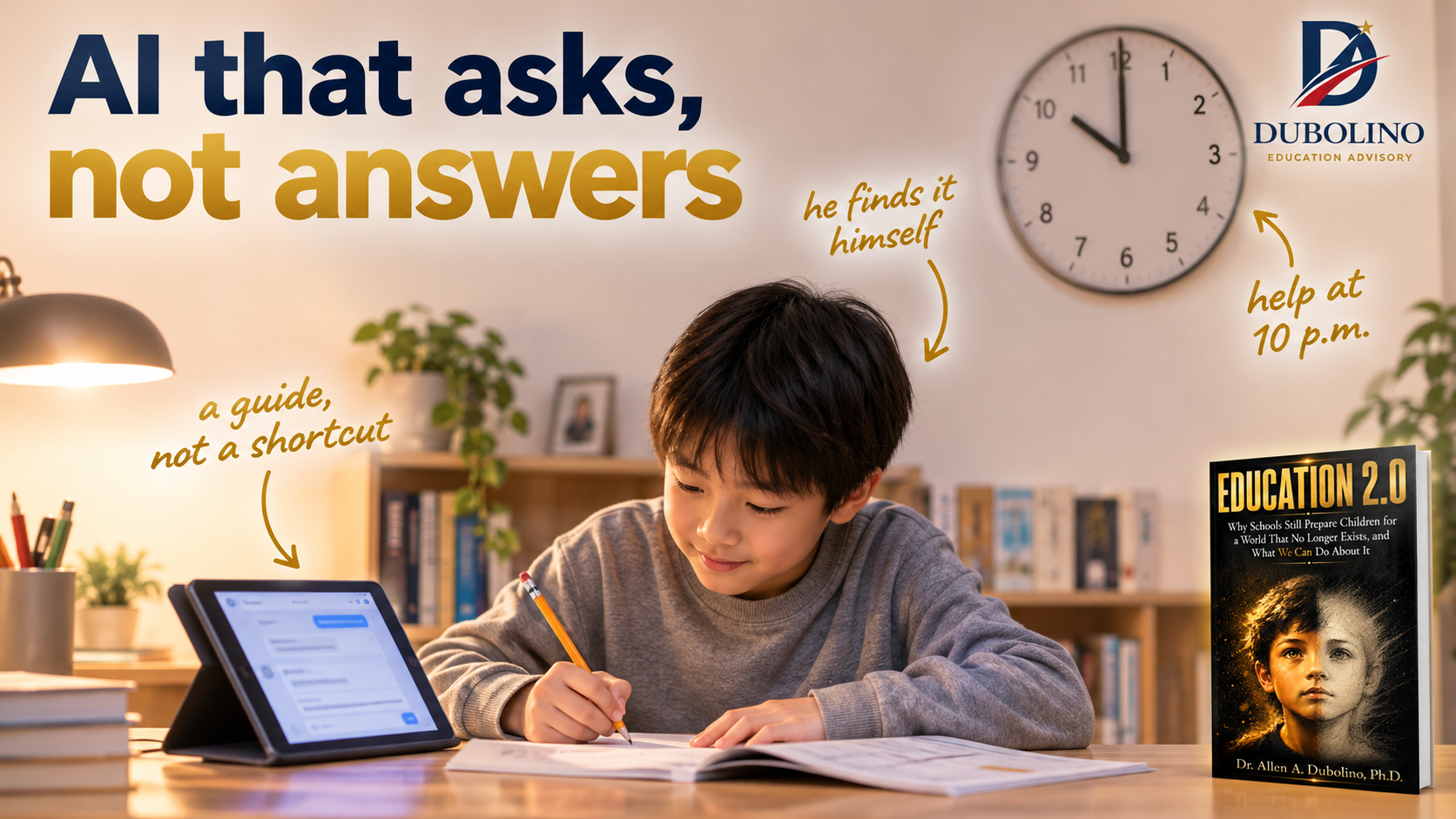
It is there at ten o'clock at night when the homework has stalled and there is no one to ask. But it does not hand over the answer. It asks a question back. What do you already know that might help here? What happens if you try the first part again, slower? It explains a hard idea a second way and a third way, until your child finds the answer themselves.
Not the Chatbot You Are Worried About
The difference between this and a general chatbot is not a matter of degree. It is a difference in kind. A general chatbot is a stranger with access to the whole internet, and it gives answers. For a child, that means the homework gets done and nothing gets learned.
A tool built properly for a school is the opposite. It runs inside a closed environment the school controls. It knows the curriculum your child is learning, what they have already mastered and where they are struggling right now. And it is designed, at its core, to keep your child in the productive struggle where real learning happens, rather than doing the thinking for them.
"The machine informs. The human decides."
The Line That Should Never Move
There is one rule that matters more than any feature. The human being always decides. The tool can flag a child who may need help or suggest a possible path. Then it stops. The teacher, who knows that this child's parents are separating, or that the suggested path is wrong for reasons no data could capture, makes the actual decision. The technology should never decide what your child is ready for, judge who your child is, or chart the course of their education. Those decisions belong to people who know and care about your child.
- Does the AI give my child answers, or guide them to find answers themselves?
- Is it a general chatbot, or a tool built for your curriculum inside a closed environment?
- What does the teacher actually see, and how does it help them notice my child?
- Who makes the decisions about my child's learning: the software or a person?
Used well, this technology never stands between your child and a human being. It clears the space so the teacher can finally see your child clearly, and it keeps your child company in the hours when no teacher can be there. That is the difference between technology aimed at children and technology built for them.
Education 2.0
Read the full chapter on the intelligence beneath a 2.0 school.
Education 2.0 lays out the six systems behind a school designed around your child, including how technology can support teachers and children without ever replacing the people who matter most.
Dr. Allen A. Dubolino, Ph.D. is the founding Head of School at New American Chinese International School (Nonthaburi, Thailand) and Head of School at Four Leaves International School Tokyo. He has 22 years of international school leadership experience across Japan and Thailand and is the founder of Dubolino Education Advisory.
