
The Principal's Perspective
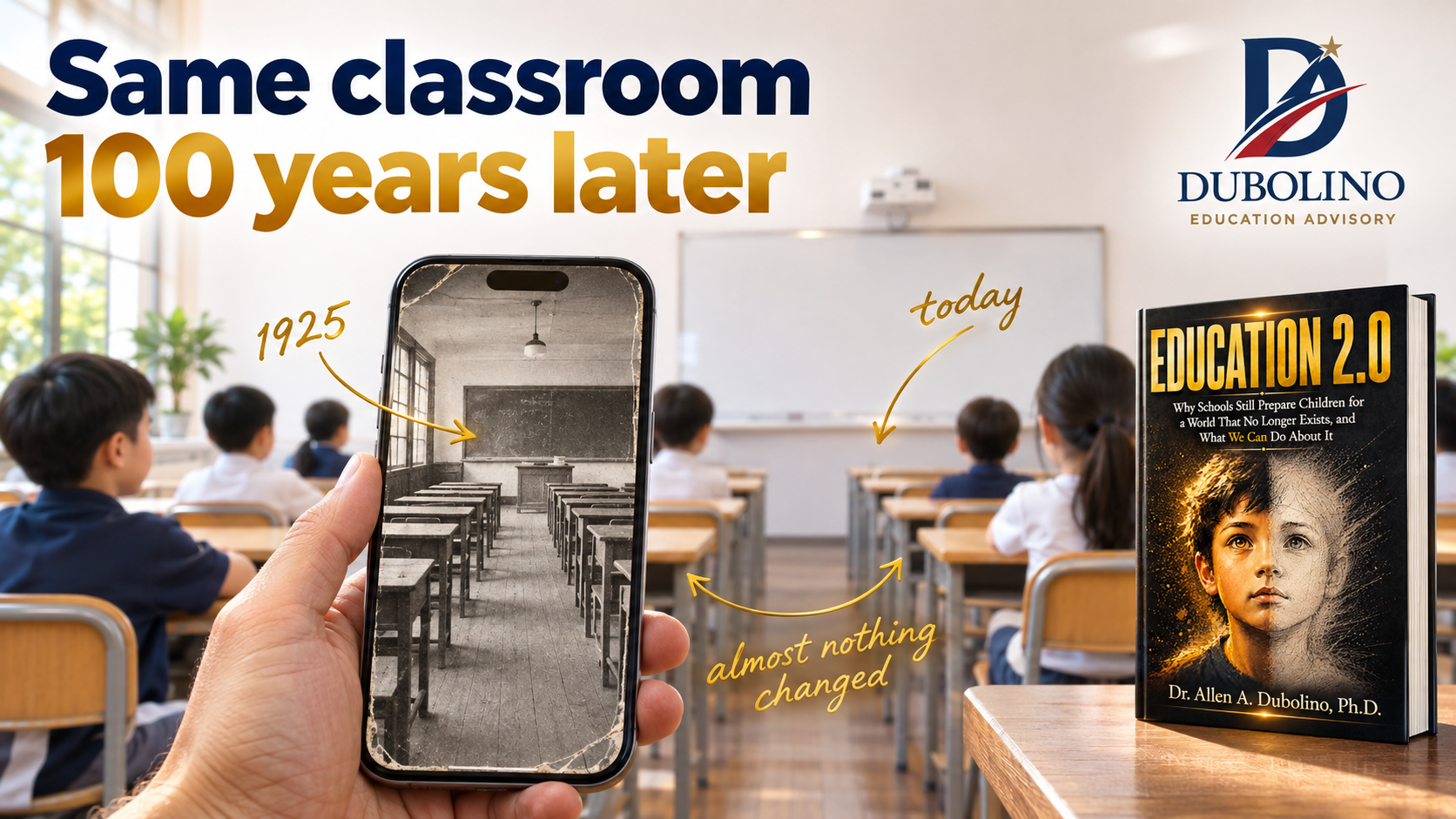
There is a photograph I want you to find tonight, on the phone that is almost certainly within reach of you right now. Search for a classroom from 1925. Wooden desks in straight rows. A teacher at the front beside a chalkboard. Children with hands folded and eyes forward, waiting to be told what to think about next.
Now hold that image in your mind and picture the room where your child spends roughly a thousand hours of every year. Look at the desks. Look at where the teacher stands. Look at the direction every child is facing.
It is the same photograph. The uniforms have changed and the board might glow now. But the shape of the moment, who speaks and who waits, who decides and who follows, is almost exactly what it was a hundred years ago. And almost nothing else in your child's life has survived the century intact.
Three People Wake Up Today
In Education 2.0, I open with a small experiment. Imagine three professionals from 1925, each the very best at their craft, fall asleep and wake up in our world this morning. We send all three to work.
Lost inside a minute
She does not recognize the monitors, the imaging or the instruments. A hundred years of progress stands between what she knows and what is now required. Nobody would let her touch a patient.
Not allowed near the runway
He looks for the propeller and there isn't one. The cockpit is a wall of glass and computation he has never seen. He cannot read a single instrument, and we would be right to keep him on the ground.
Ready to teach this morning
She walks into your child's classroom, finds the desks in rows and the board at the front, picks up a marker and begins. The children follow. The structure holds. Most people watching would notice nothing strange at all.
We often tell this story as if it were charming, proof of how timeless teaching is. It is not charming. Medicine, flight, work and communication have all been rebuilt, again and again. The one institution whose whole purpose is to prepare children for the future is the one that has most stubbornly refused to be touched by it.
Not the Teacher's Fault
I need to be very clear here. None of this is the teacher's fault. The teacher in your child's classroom is very likely one of the most dedicated, underpaid and quietly heroic people your family will ever depend on. She did not design the rows or the rule that every child moves at the same speed. She inherited a machine and was asked to make miracles happen inside it, and very often she does. The problem is the model, never the people working inside it.
The Boy in the Hallway
I learned what the model misses in my first years teaching in Thailand, from a Korean boy named Su. Every school has a Su: the child teachers quietly warn each other about. He never does his homework. He will fail anyway. By the time he reached my class, he had heard that story so often he believed it.
One afternoon he failed another spelling test, and I lost my temper with him in the hallway. More than twenty years later I still wish I had done it differently. Su began to cry, and I apologized. Then he told me he was not crying because I had yelled. He was crying because I was the first teacher who had ever seemed to care whether he passed. Su had never needed another worksheet. He needed to be seen, and once he was, he slowly began to become someone else.
"Children almost never become who we label them to be. They become who someone finally believes they can be."
Why This Is About Your Child
It would be easy to read all this as a general complaint about education and forget it by dinner. But your child gets one childhood, one pass through the years when a mind is most open. The future will not ask them to sit still and repeat facts on command. Machines do that now, instantly and for free. It will ask them to think, create, judge what is true, work with other people and adapt when the ground shifts. The 1925 model was never built to develop any of that.
- Which way the children are facing, and who is doing most of the talking.
- Whether every child is on the same page at the same time, or working at their own level.
- Whether the teacher knows each child as a person, not just as a grade.
- Whether the room would look familiar to someone from 1925.
So go and find the photograph. Put it beside the room your child sat in today, and let the sameness disturb you a little. It is not proof that we got school right a hundred years ago. It is proof that school stopped changing while the world your child must live in kept moving. That classroom does not have to be your child's classroom.
Education 2.0
Start with the photograph that should disturb you.
Education 2.0 explains why the classroom has barely changed in a century, and lays out the six systems behind a school built around who children really are.
Dr. Allen A. Dubolino, Ph.D. is the founding Head of School at New American Chinese International School (Nonthaburi, Thailand) and Head of School at Four Leaves International School Tokyo. He has 22 years of international school leadership experience across Japan and Thailand and is the founder of Dubolino Education Advisory.
