
The Principal's Perspective
A father once sat across from me with a question he was almost embarrassed to ask. His daughter was eleven, bright, the kind of child who collects gold stars the way other children collect scraped knees. By every measure the school gave him, she was doing beautifully. And still he lowered his voice and said: "I do everything I am supposed to. But I have this feeling I cannot shake, that I am preparing her for a world that is not going to be there when she grows up."
I have heard some version of that question from more parents than I can count, in more countries than I can count. Here is what I told him: that feeling is not anxiety to be managed away. It is one of the most accurate instincts a parent can have right now.
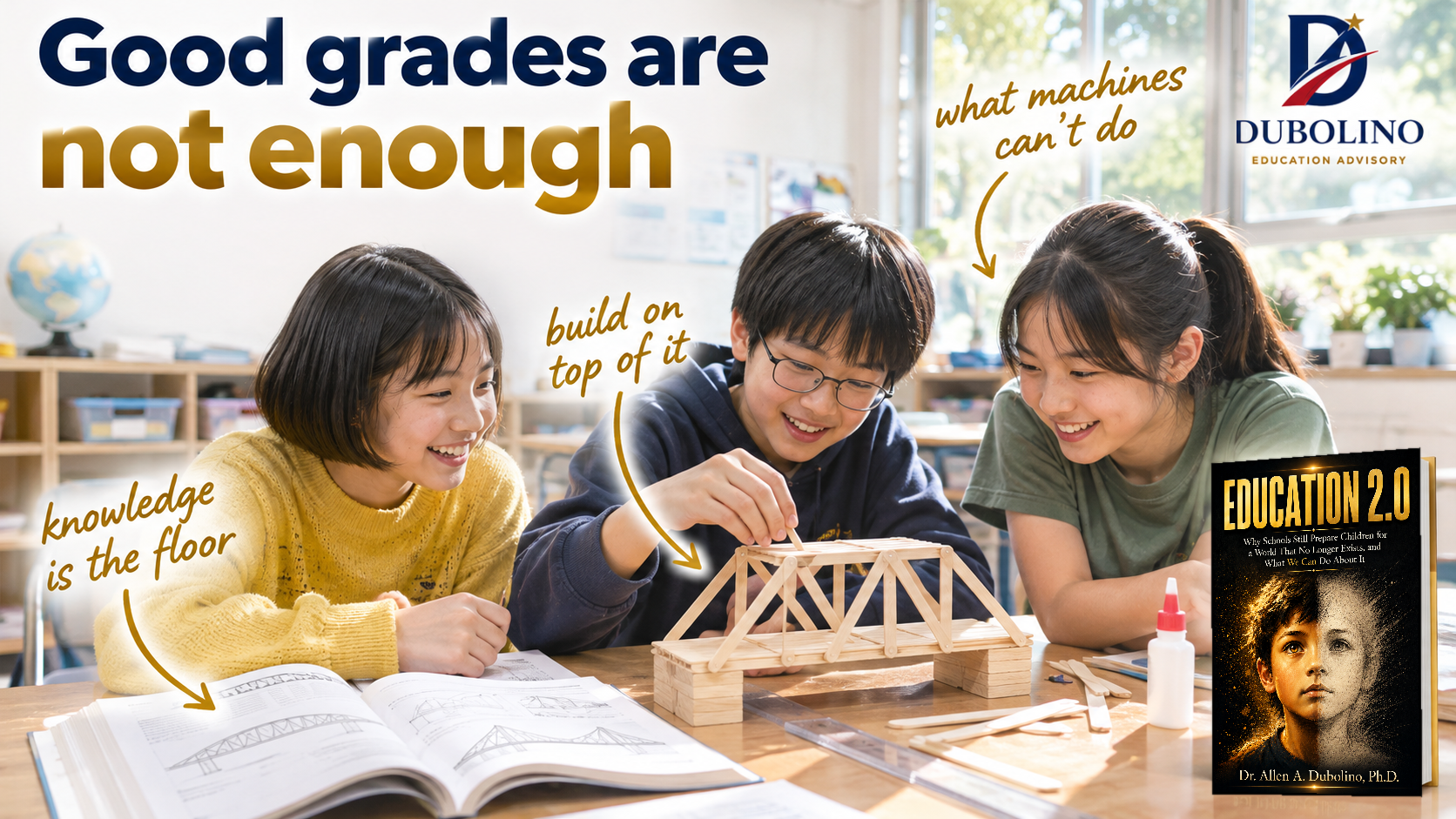
Knowledge Has Changed Position
For most of history, knowing things was a kind of wealth. Knowledge was scarce, and the person who knew more could do more. The traditional classroom was built on that idea: pour the facts in, test whether they stuck, certify the children who kept the most.
Your child is growing up in the first moment in history when the answer, by itself, is free, instant and everywhere. The device in your pocket will not only look things up. It will write the essay, solve the equation and explain the reasoning in seconds.
I want to be careful here, because this does not mean knowledge no longer matters. It matters as much as ever. You think with what you know, and a child who knows nothing is not freed by a machine that knows everything. They are helpless in front of it. What has changed is where knowledge sits.
Knowledge was the ceiling
It was the highest thing a school could give a child and the thing children were measured against. Recall the most, and you finished at the top.
Knowledge is the floor
It is the ground a child stands on in order to do what actually counts: to create, to judge, to adapt, and to make something a machine cannot. The problem with many schools is not that they teach children things. It is that they still treat the floor as the finish line.
Skills Now Expire
It is not only facts. Specific skills are going stale faster than most parents realize. The particular software, method or tool your child spends a year mastering may be out of date before they finish school. So the most lasting thing a school can build is not one specific skill. It is the ability to learn the next one quickly, and the one after that, across a life that will ask for reinvention again and again.
"Knowledge has not stopped mattering; it has changed position."
A Better Question Than "What Job?"
Underneath that father's worry was the question almost every parent carries: what is my child actually going to do? I cannot tell you which jobs will exist when your child is grown, and you should be wary of anyone who says they can. But that is the wrong question, because nobody can hit a target that keeps moving.
The better question has a stable answer: what will people still be needed for, when machines can do almost everything that can be written down as a procedure? A machine can write an essay on courage, but it has never been afraid and pushed forward anyway. It can describe a friendship, but it has never had one.
- Create original ideas that come from a lived life, not reshuffled patterns.
- Hold real convictions, and stand behind them when it costs something.
- Build genuine relationships and earn other people's trust.
- Get knocked down by real life, and get back up.
- Judge what should be done, not just what can be done.
Notice that this is not a list of subjects. It is a list of human capabilities, and it is almost exactly the list the traditional classroom was never designed to develop. Employers already see the gap: graduates arrive with strong transcripts, then struggle with messy problems that have no answer key, or with thinking on their feet and working through disagreement. That is not a failure of the students. They did everything asked of them. It is a failure of the model.
So I told that father the truth. His instinct was right, and the gold stars were real too. Both were true at once. But the future is not a mystery. It will need his daughter to think for herself, to create, to keep going, to judge wisely, and to be someone people trust. All of those can be developed on purpose, by a school designed to develop them. When you visit a school, ask how it builds them.
Education 2.0
Read the full chapter on the world your child will actually enter.
Education 2.0 explains why the classroom has barely changed while the world has changed completely, and lays out the six systems behind a school built for the future your child will really face.
Dr. Allen A. Dubolino, Ph.D. is the founding Head of School at New American Chinese International School (Nonthaburi, Thailand) and Head of School at Four Leaves International School Tokyo. He has 22 years of international school leadership experience across Japan and Thailand and is the founder of Dubolino Education Advisory.
