
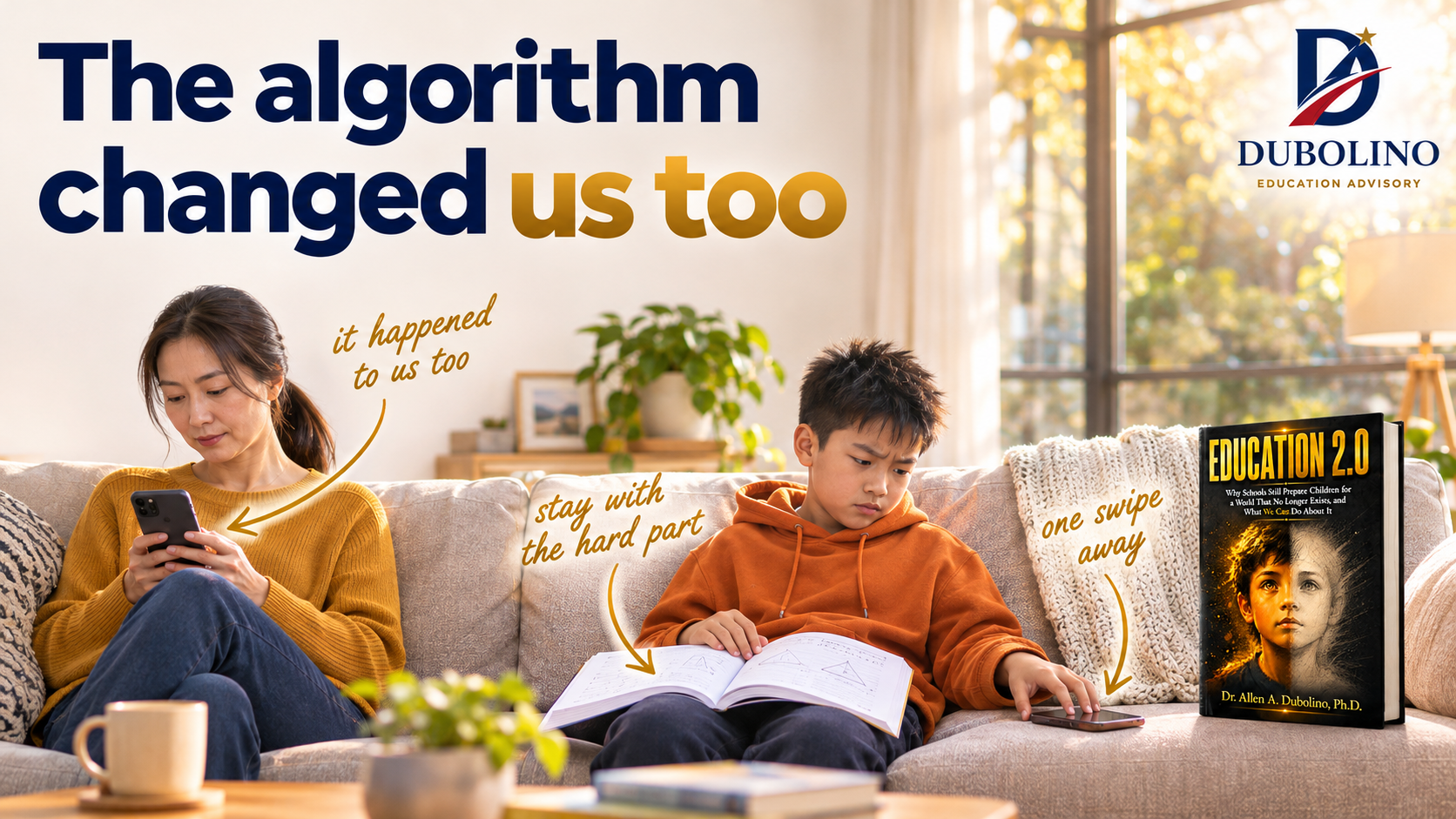
The Principal's Perspective
Watch a child try to be bored. A waiting room, a long car ride, ten empty minutes with nothing in them. Watch how fast the hand goes to the pocket, and how quickly the screen comes up, almost like pulling away from a hot stove. It looks less like a choice and more like relief.
Before you shake your head at the child, notice your own hand. Mine does it too. In the pause while the kettle boils, in the three seconds a page takes to load, my hand goes to my pocket. I have caught myself reaching for my phone while already holding my phone.
In Education 2.0, this is the chapter where the conversation stops being about schools and starts being about the people in your own home. The same force that changed the world your child will enter also quietly changed the two people living in your house: your child, and you.
Systems Built to Hold Attention
For about twenty years, most of us have lived inside the feeds, platforms and endless scrolling streams on the screens we carry everywhere. Those systems were never neutral. They were engineered, brilliantly, to capture and hold human attention for as long as possible. Every notification, every autoplay and every little red badge was refined against one question: does this keep the person looking?
Twenty years inside that environment changes people. Not just children. All of us. And it shows up in your child's learning in two very specific ways.
Difficulty feels like a signal to escape
Real learning always passes through a hard stretch, the moment where you don't get it yet and want to quit. That moment is where learning actually happens. But a child raised with relief always one swipe away learns that boredom and frustration mean something has gone wrong. So when they meet a hard math problem or a book that doesn't give up its meaning easily, everything in them says: leave. The classroom is asking them to do the one thing the rest of their world has trained them never to do. Stay.
Correction feels like an attack
Feeds keep us engaged by showing us what we already agree with. Years inside a world that rarely contradicts you weakens the ability to hear "this isn't right yet" and treat it as help. Yet school runs on exactly that kind of feedback. When correction feels like a wound, the most ordinary acts of teaching start to misfire, through no fault of the teacher and no fault of the child.
"This is not a willpower failure in your child. It is not laziness, and it is not a character flaw."
The Uncomfortable Mirror
The same systems shaped parents too, and they shaped us in one place that matters a great deal: how we hear about our children's schools. What keeps people engaged online is rarely calm, balanced information. It is alarm. The viral story about a school that failed a child, the thread about the terrible teacher. So many parents now arrive at the school door already primed to suspect, and to read the worst into an ambiguous email.
I don't say this to scold anyone. Parents love their children as fiercely as they ever have. But seeing the machine is the first step to stepping outside it. Some of the wariness you feel toward your child's school is earned. Some of it was installed. Once you can see that, you can decide which is which.
A Design Problem Has a Design Solution
Most schools were built for children who could tolerate boredom, take correction calmly, and parents who gave the school the benefit of the doubt. Those are not the people who show up now. Many schools treat the gap as a discipline problem, a motivation problem or a parent problem. It is really a design problem, and a school can be designed for the children who actually exist today: one that helps them rebuild their tolerance for difficulty, gives feedback in a way they can actually hear, and earns parents' trust on purpose.
- How do you help children stay with a task when it gets hard, instead of giving up or moving on?
- How do teachers give feedback so that a child hears it as help, not as an attack?
- How are screens and devices used in class, and when are they put away?
- How do you build trust with parents before there is a problem?
None of this is your child's fault, and none of it is yours. But it does mean the right school today is not simply the one that looks the most impressive. It is the one that understands the child sitting in the room, and was built for them.
Education 2.0
Read the full chapter on how the algorithm changed your child, and you.
Education 2.0 explains why today's schools were built for children who no longer exist, and lays out the six systems behind a school designed for the ones who do.
Dr. Allen A. Dubolino, Ph.D. is the founding Head of School at New American Chinese International School (Nonthaburi, Thailand) and Head of School at Four Leaves International School Tokyo. He has 22 years of international school leadership experience across Japan and Thailand and is the founder of Dubolino Education Advisory.
