
Bored or Lost: Why One Lesson Doesn’t Fit Every Child
The Principal's Perspective
In Education 2.0, Dr. Allen Dubolino introduces a ten-year-old girl he calls Mia and follows her through the same 45-minute math lesson on fractions twice: once in the kind of classroom most children sit in today, and once in a classroom designed differently.
The difference between those two mornings explains a lot about why some children quietly decide they're "just not good at math."
One lesson, many different levels
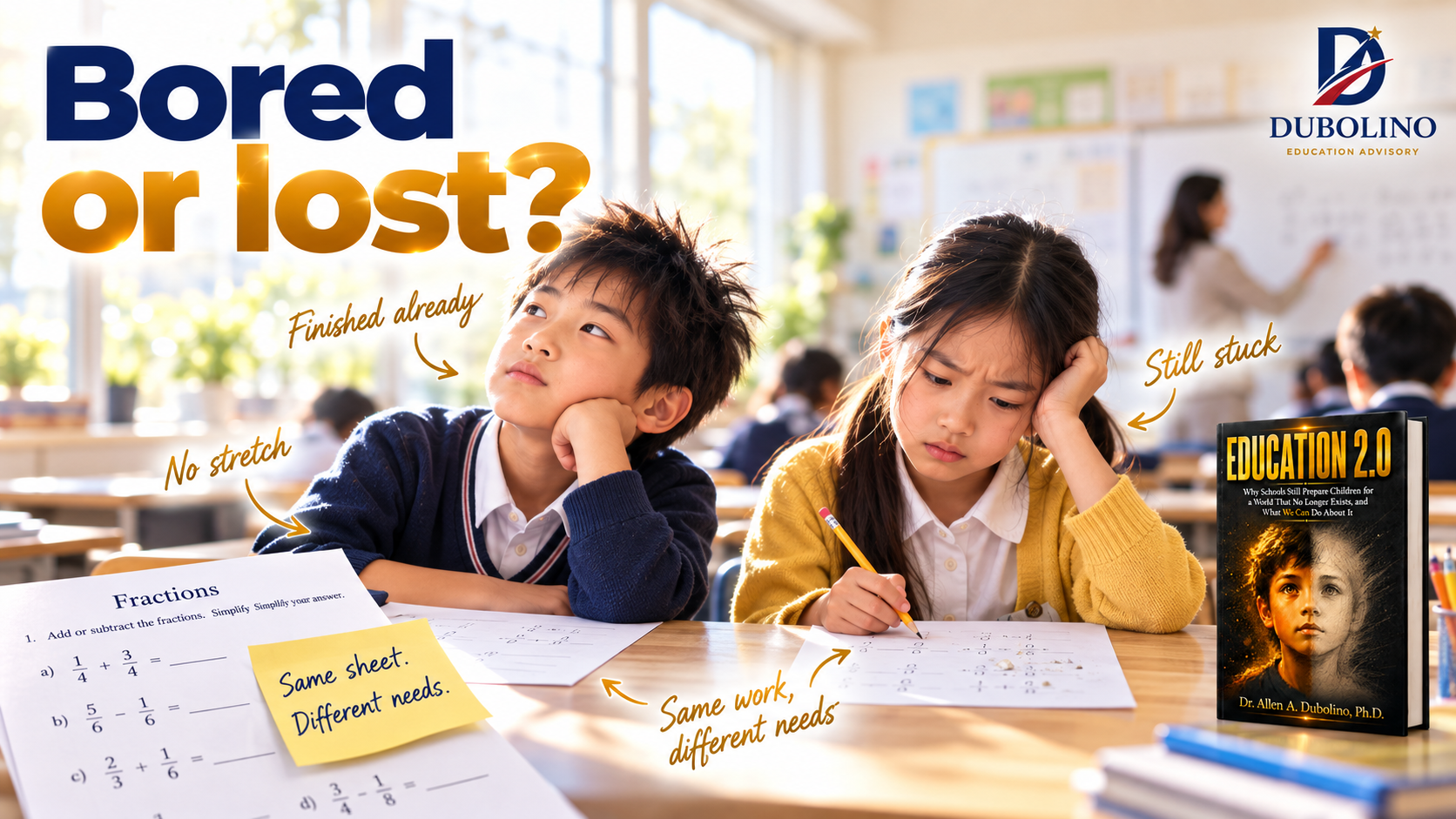
In a typical classroom, one teacher gives one lesson to around 25 children at the same time. She's a good teacher and she has prepared carefully. But those 25 children are never at the same level. Some understood fractions months ago. Others are missing a piece from last year that today's lesson assumes they already have.
The teacher can only aim her lesson at one level, so she aims for the middle. The children who are ahead spend the lesson bored. The children who are behind spend it lost. On an ordinary day, at a good school, that can be more than half the room.
When Mia gets stuck and raises her hand, the teacher comes over to help. But there are other hands up too, and after a minute or two she has to move on. Mia is left with a half-explained problem and a feeling that she isn't a math person. She's wrong about that, but the structure of the room taught her to believe it.
The problem isn't the teacher. It's a structure that asks one person to teach 25 different levels at the same time.
The same lesson, designed differently
In the second classroom, the same 45 minutes are divided into three parts, each with a different purpose.
The teacher teaches
For the first 15 to 20 minutes, the teacher explains the idea to the whole class, thinks out loud, asks questions and watches faces to see who understands. This part stays human, because nothing helps a child understand an idea like a skilled teacher explaining it.
Every child practices at their own level
Each child then practices with software matched to exactly where they are. Children who are ahead get harder problems. Children who are behind go back and fill in what they missed. Mia gets practice that fits her, adjusting as she works.
Meanwhile, the teacher can see how each child is doing and spends her time with the ones who need her most, for as long as it takes, not just a minute or two.
Children use what they learned
Finally, students apply the idea to something real, like a design problem or a small project they present to others. This is where children stop only receiving knowledge and start creating with it.
Technology plays a role, but it isn't the center of the room. It handles the part no single teacher can do alone, giving 25 children 25 different sets of problems, so the teacher has more time for the human part of the job.
Taught at the right level
The book sums up the difference simply. In the first classroom, every child is taught at the average, which means very few are taught at their own level. In the second, every child is taught at their edge: hard enough to grow, but not so hard that they give up.
Dr. Dubolino is also honest that this is a design his team is building now at their new school, not a model with decades of results behind it. The individual pieces, clear teaching, practice matched to each child, and learning through real projects, are well established. What's new is putting them together in one school day.
What to ask a school
You can learn a lot about how a school handles different levels by asking a few direct questions.
- What happens in a lesson for a child who already understands the topic?
- What happens for a child who is missing something from an earlier year?
- How much time does the teacher get to work one-on-one with students?
- How do you use technology, and what does it change about a typical lesson?
- How often do students apply what they've learned in a real project?
Many children who believe they "aren't smart" were simply taught at the wrong level for too long. The right classroom meets your child where they actually are.
Dubolino Education Advisory
Wondering if your child is being taught at the right level?
We help families in Japan and Thailand find schools that fit their children. Get in touch if you'd like help thinking through your options.
Dr. Allen A. Dubolino, Ph.D., is Head of School at Four Leaves International School Tokyo and the founding Head of New American Chinese International School in Thailand. He has led international schools in Japan and Thailand for 22 years and is the founder of Dubolino Education Advisory. His book, Education 2.0: Why Schools Still Prepare Children for a World That No Longer Exists, and What We Can Do About It, is available now.
