
Three Things You Can Build at Home, Whatever School Your Child Attends
The Principal's Perspective
Many of the articles on this blog are about choosing the right school. But for a lot of families, changing schools isn't a realistic option. Cost, location, friendships and timing all get in the way.
In Education 2.0, Dr. Allen Dubolino speaks directly to those parents. His message is reassuring: if you can't change your child's school, that isn't a failure on your part. And many of the most important things a child needs don't depend on the school at all.
The school occupies many of your child's hours. But you occupy the ones that often matter most.
Three things you can build at home
The book names three capacities that will matter most in the world children are growing into: the ability to create, the resilience to recover from setbacks, and the independence to think for themselves. None of them requires a special program or device.
The ability to create
Many loving parents fill every free hour with activities or screens. But children often create things when they have unstructured time and get a little bored.
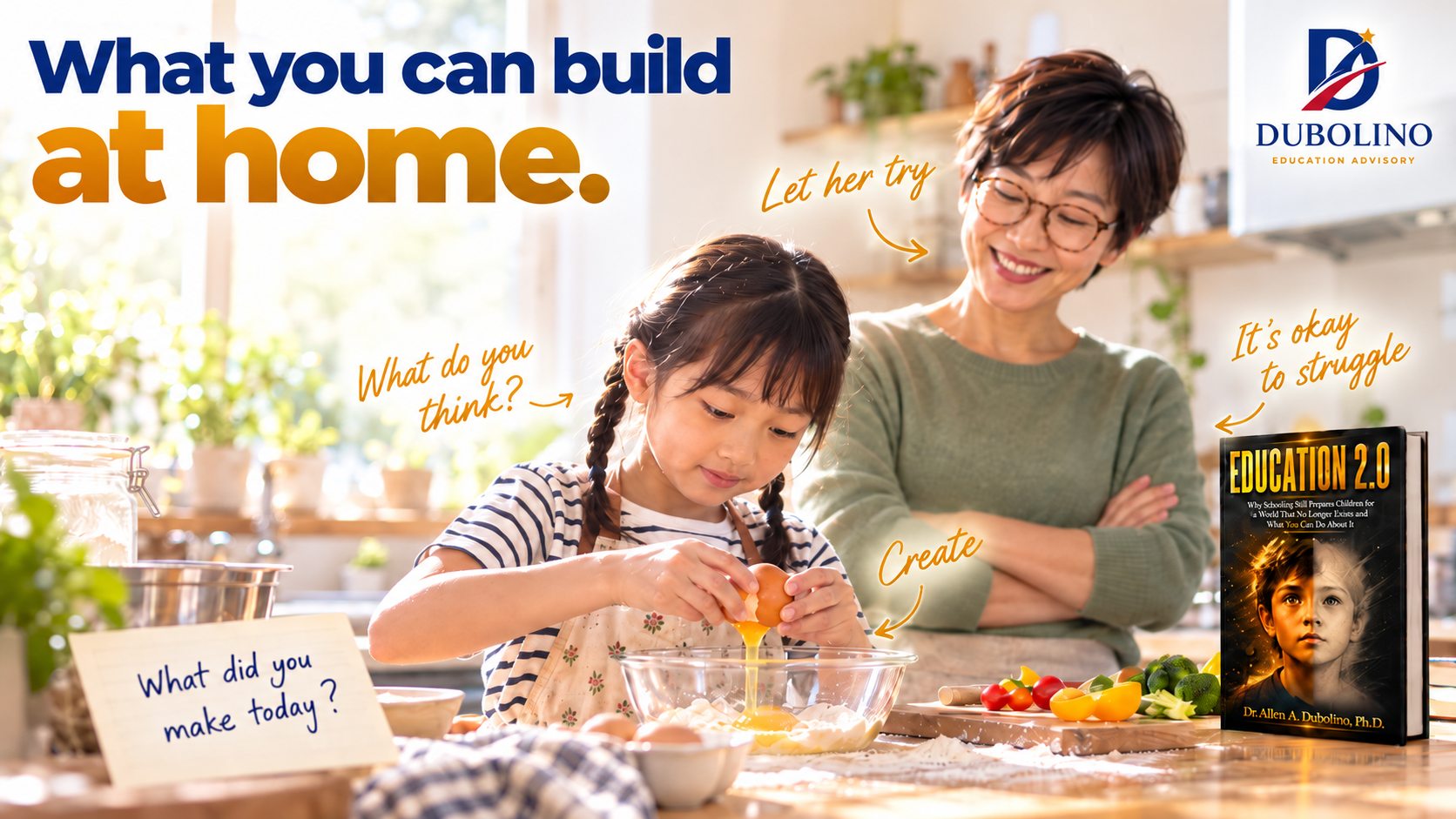
Leave some hours open, and give your child a real task instead of entertainment. Let them cook a simple meal for the family, plan a weekend outing, or fix something around the house. Let them decide how, and let them sometimes get it wrong.
Resilience
This one is hard for parents, because it means not stepping in too quickly. When your child struggles with a puzzle, a friendship or a difficult task, the natural reaction is to fix it for them.
Within reason, try not to. Sit beside them and say, "I know it's hard. What could you try next?" A child who learns at ten that failure can be survived is much better prepared to handle it at thirty.
Thinking for themselves
Make the dinner table a place where your child is asked what they think and taken seriously. Ask questions without a neat answer, about a story, a decision or something in the news that suits their age.
Then listen, and let them disagree with you. A child who learns to respectfully disagree at home is learning to hold their own view under pressure.
Change the questions you ask
The most common question parents ask after school is some version of "What did you get?" Grades matter, but they show only a small part of who your child is becoming.
- What did you make or try this week?
- What was hard today, and how did you deal with it?
- What do you think about that, and why?
- What would you do differently next time?
You won't put a score on any of this, and you don't need to. The point is to notice and encourage the whole child, not only the part a report card measures.
When something goes wrong
The book also suggests a calmer way to handle mistakes at home. Instead of a lecture, ask questions: What happened? What were you feeling? Who was affected? What would make it right? There can still be a consequence, but the focus is on helping your child understand and grow. Over time, they learn that a mistake doesn't define them.
Working with your child's school
If you have concerns about your child's school, the book's advice is to raise them as a partner, not an opponent. Speak first with the teacher closest to your child, ask your questions calmly, and assume good intentions. Most teachers are doing their best inside a system they didn't design.
You may not be able to change your child's school, but you are still the biggest influence on their education, and you can start this weekend.
Dubolino Education Advisory
Not sure if your child's school is the right fit?
We help families in Japan and Thailand understand their options, whether that means a new school or making the most of the current one. Get in touch if you'd like to talk it through.
Dr. Allen A. Dubolino, Ph.D., is Head of School at Four Leaves International School Tokyo and the founding Head of New American Chinese International School in Thailand. He has led international schools in Japan and Thailand for 22 years and is the founder of Dubolino Education Advisory. His book, Education 2.0: Why Schools Still Prepare Children for a World That No Longer Exists, and What We Can Do About It, is available now.
