
Preparing Your Child for Jobs That Don’t Exist Yet
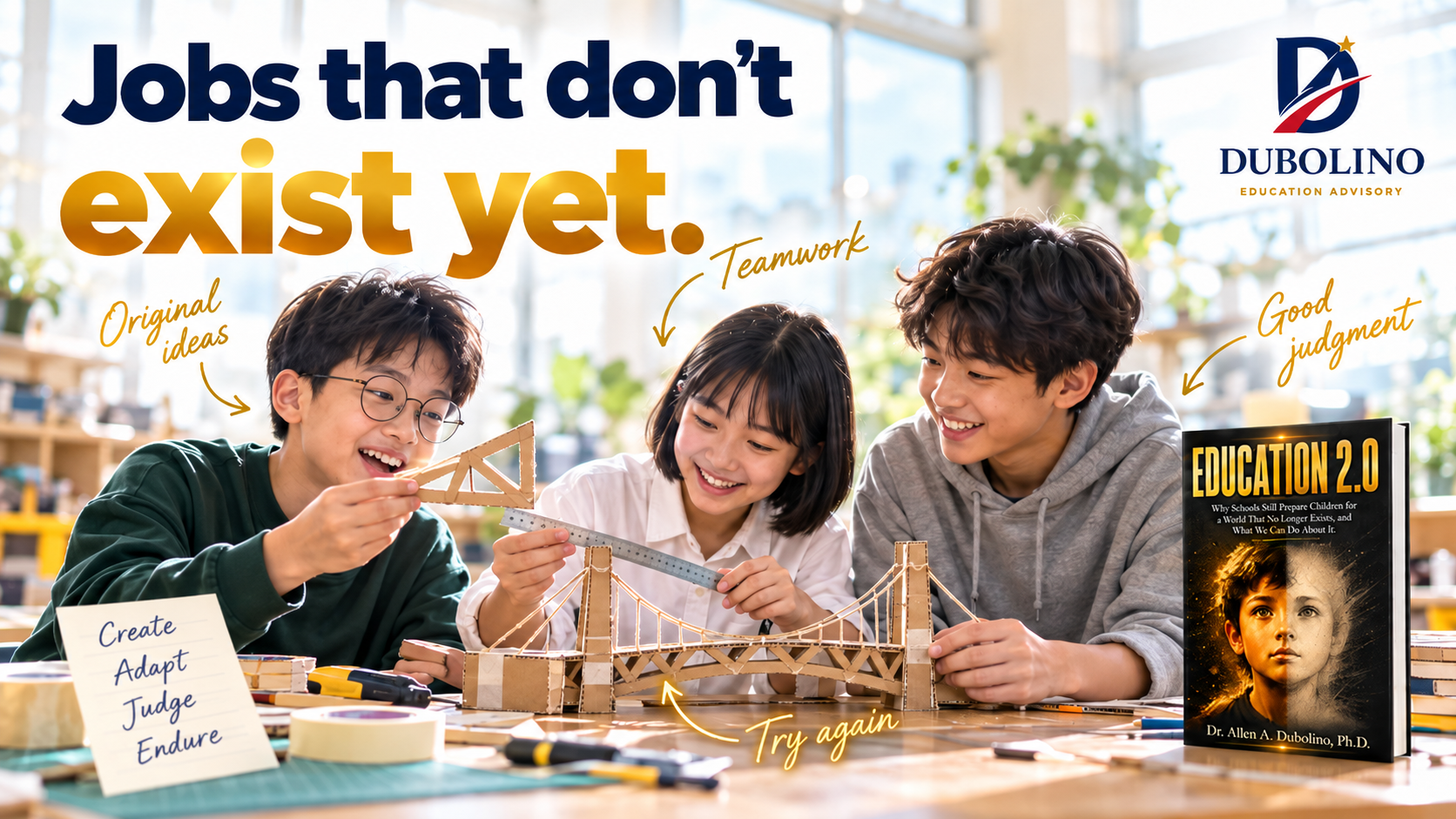
The Principal's Perspective
In Education 2.0, Dr. Allen Dubolino describes a father whose eleven-year-old daughter was doing everything right. Good grades, finished homework, gold stars. And yet he admitted a worry he couldn't shake: "I have this feeling that I am preparing her for a world that is not going to be there when she grows up."
Many parents share that feeling. Dr. Dubolino's answer is that the instinct is reasonable, and that there is something clear parents can do about it.
Knowledge still matters, but it's no longer enough
For most of history, knowing things was valuable because information was hard to get. Schools were built around that idea: teachers pass on knowledge, students absorb it, and exams check what they remember.
Today, answers are free and instant. AI tools can explain, summarize, solve and write in seconds.
The book is careful here. It doesn't say knowledge has become worthless. Children still need knowledge to think, to judge whether an answer is good, and to be creative. What has changed is its role. Knowledge used to be the finish line. Now it's the starting point, the foundation children need in order to create, decide and adapt.
Skills now expire faster
It isn't only facts. Specific technical skills now go out of date in years rather than decades. The software or method a child spends a year learning may be replaced before they finish school.
That changes what's worth building. If specific skills expire, the lasting advantage is the ability to learn new ones quickly and adapt when things change.
The lasting asset isn't what your child knows. It's what your child can do when what they know runs out.
A better question than "What job will my child do?"
No one can say for sure which jobs will exist in fifteen years, and the book is honest about that. Instead, it suggests asking a different question: what will people still be needed for when machines can do most routine tasks?
That question has a clearer answer. The book lists five human capabilities that machines can't replace.
Original ideas
Ideas that come from lived experience, not rearranged patterns.
Conviction
Standing behind a belief even when it costs something.
Trusted relationships
Working well with others and being someone people can rely on.
Resilience
Getting knocked down by real setbacks and getting back up.
Ethical judgment
Deciding what should be done, not only what can be done.
This isn't a list of school subjects. It's a list of human capabilities, and most traditional classrooms weren't designed to develop them.
Employers are already noticing
According to the book, people who hire young graduates describe the same pattern across industries. Graduates arrive with strong grades and credentials, but many struggle with messy problems that have no answer key, thinking on their feet, or working through conflict with colleagues.
The book is clear that this isn't the graduates' fault. They did everything the system asked. The system was aiming at the wrong target.
What to ask a school
These capabilities can be developed on purpose. The question is whether a school is designed to do it.
- How do students practice solving problems that don't have one right answer?
- How often do students work on real projects with other students?
- How do you help students recover when something they try doesn't work?
- How do you teach students to use AI tools without depending on them?
- Beyond grades, how do you know if a student is growing?
The father in the book was right to worry. But the future isn't a mystery. It will need children who can think for themselves, create, recover from setbacks, and work well with others, and those qualities can be built.
Dubolino Education Advisory
Looking for a school that prepares your child for what's ahead?
We help families in Japan and Thailand find schools that fit their children. Get in touch if you'd like help thinking through your options.
Dr. Allen A. Dubolino, Ph.D., is Head of School at Four Leaves International School Tokyo and the founding Head of New American Chinese International School in Thailand. He has led international schools in Japan and Thailand for 22 years and is the founder of Dubolino Education Advisory. His book, Education 2.0: Why Schools Still Prepare Children for a World That No Longer Exists, and What We Can Do About It, is available now.
