
The Question Most Parents Never Ask: How Does This School Choose Its Teachers?
The Principal's Perspective
Think back to your own school years and what made a year good or bad. For most people, it wasn't the building or the curriculum. It was a person: the teacher who noticed you, or the one who didn't.
In Education 2.0, Dr. Allen Dubolino points out that the single biggest factor in how your child's year goes is which adult they're placed with. That raises a question most parents never ask a school: how do you decide who that person will be?
How most schools hire
In most schools, the process looks the same. A job is posted, candidates send a CV, a few are invited to an interview of about an hour, and one is offered the job.
That process was never good at seeing what matters most in a teacher. A CV shows where someone studied and worked. An interview shows whether they can be pleasant and composed for an hour. Neither shows whether they'll be patient with a struggling child on a difficult day when no one is watching.
Dr. Dubolino argues the problem has become worse. A polished CV can now be produced in seconds, and common interview questions can be rehearsed in advance. The things the traditional process rewards are now easy for anyone to produce, so they say very little about the actual person.
What a good teacher actually needs
Instead of focusing on credentials, the book suggests looking for a few human qualities that predict who will be a great teacher for your child.
Discipline
Someone who shows up and does the work on the hard days, not only the good ones.
Drive
A real reason for choosing this work. A person who teaches because they care about children behaves differently over a long year than someone who just needed a job.
Passion
The kind of energy you can feel in a room, and that no script can produce.
The ability to handle complexity
Classrooms and children are complicated. A good teacher can work with that without oversimplifying a child or a situation.
A different way to hire
The book describes a hiring process designed to see the real person behind the CV. Candidates answer a few questions on video that they couldn't have prepared for, such as describing a time they were wrong about something important. In the interview, candidates ask their questions first, because what someone wants to know first, whether it's the children or the holidays, says a lot.
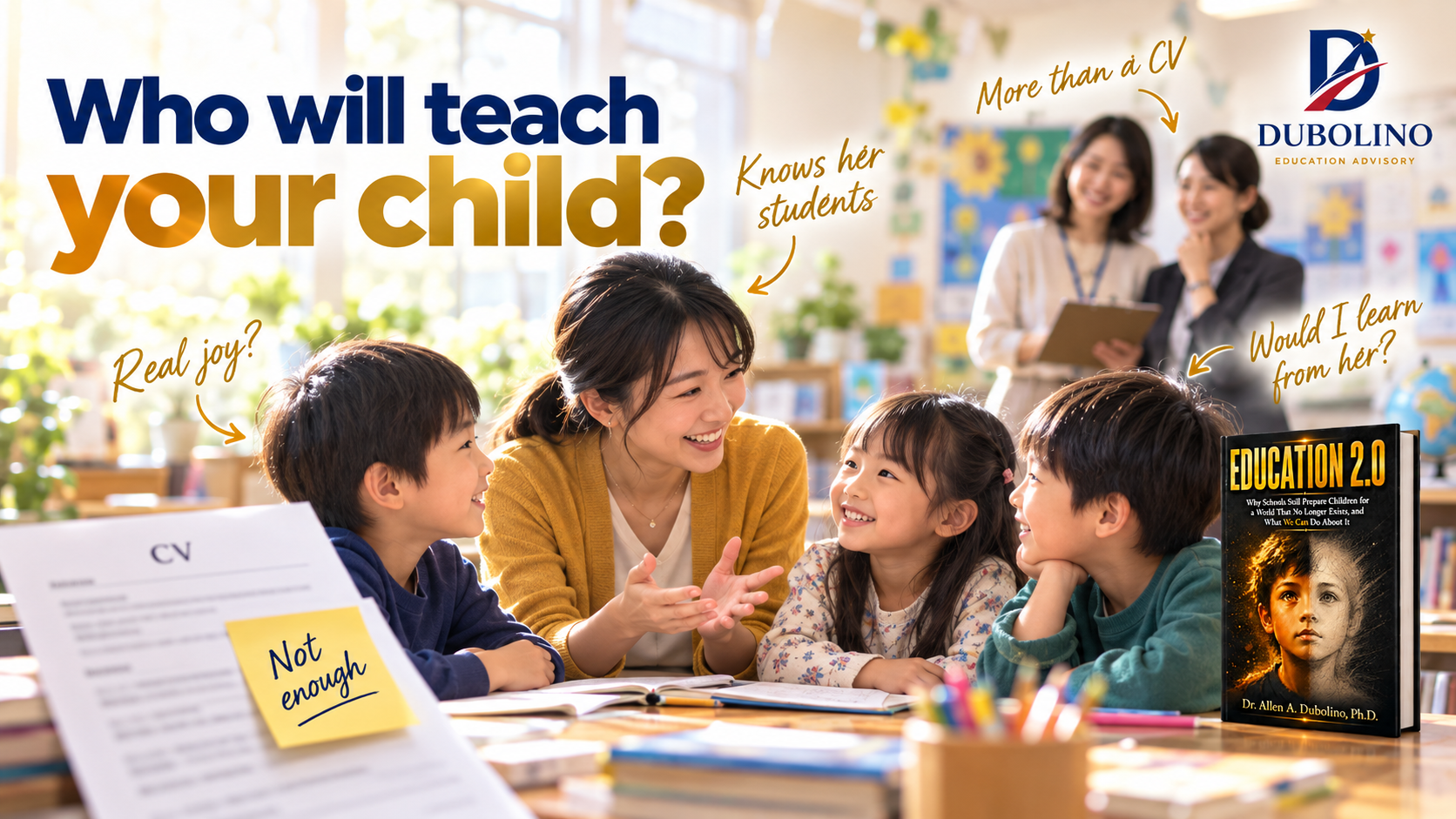
Most importantly, candidates spend a day at the school. They teach a real lesson while future colleagues watch, asking simple questions: Does this person connect with the students? Is there real enjoyment in the room? Would I want to learn from them as a child? Then they have lunch with the team, without school leaders at the table.
The question isn't whether a candidate is acceptable. It's whether the school is genuinely convinced they belong with its children.
If the honest answer is "maybe," the answer is no. The book argues that an empty position is better than a mediocre hire, because an open position can be filled later, but a child can't get back a year spent with the wrong teacher.
What to ask a school
You can't sit in on a school's hiring process, but you can ask about it. A school that takes hiring seriously will be glad you asked.
- How do you choose your teachers? Is it more than a CV and an interview?
- Do candidates teach a lesson before they're hired?
- Who is involved in the decision? Do current teachers have a say?
- Have you ever left a position open rather than hire someone you weren't sure about?
- How long do teachers usually stay at your school?
Most schools leave the most important decision about your child's year partly to chance. The right school treats it as the decision that matters most.
Dubolino Education Advisory
Want to know what to look for in a school's teachers?
We help families in Japan and Thailand find schools that fit their children. Get in touch if you'd like help thinking through your options.
Dr. Allen A. Dubolino, Ph.D., is Head of School at Four Leaves International School Tokyo and the founding Head of New American Chinese International School in Thailand. He has led international schools in Japan and Thailand for 22 years and is the founder of Dubolino Education Advisory. His book, Education 2.0: Why Schools Still Prepare Children for a World That No Longer Exists, and What We Can Do About It, is available now.
