
AI and Your Child's Homework: What a Good School Should Promise
The Principal's Perspective
It's ten o'clock at night. Your child is at the kitchen table, stuck on a math problem. The pencil has stopped moving. You'd like to help, but it's been years since you did this kind of math, and the way it's taught now is different from how you learned it.
In Education 2.0, Dr. Allen Dubolino calls this "the ten o'clock problem." Every child eventually gets stuck when the teacher has gone home and no one else can help. What happens next matters. A child who gets unstuck learns that confusion is temporary. A child who stays stuck, night after night, starts to believe they just aren't good at this.
This is where the book makes its case for AI in education, and it's more careful than you might expect.
Your concern is reasonable
Many parents feel uneasy when AI and children come up together. After years of apps and feeds designed to hold children's attention, that caution makes sense.
The book doesn't ask parents to drop that caution. It argues the opposite: parents should ask hard questions about any technology put in front of their child, and a trustworthy school should welcome those questions.
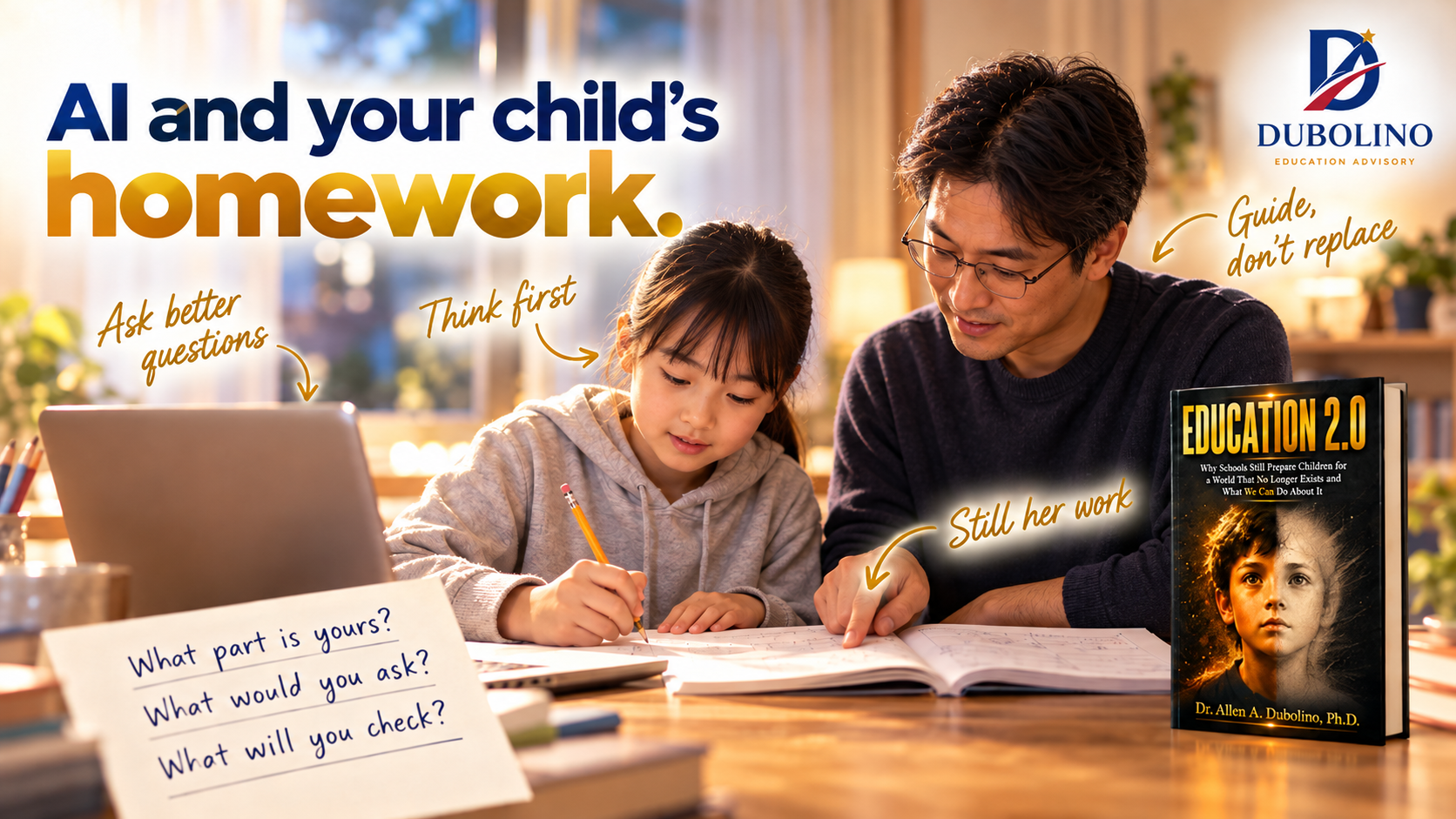
Guide, don't give the answer
The key difference is simple. A poorly designed tool gives the answer. The homework gets done, but nothing is learned, except that hard thinking can be handed off to a machine.
A well-designed learning mentor does what a good teacher does. When a child is stuck, it asks questions instead: What do you already know about this? What have you tried? What do you notice here? It guides the child toward the answer step by step, so the understanding belongs to the child.
The child still does the thinking. The mentor just makes sure they aren't left alone in the struggle.
The guardrails that matter
The book sets out clear limits that any school using AI with children should follow.
It guides. It never just gives the answer.
The whole point is to keep the thinking with the child. A tool that skips the struggle would undo the very thing it was meant to build.
It's built for the school, not the open internet.
A general chatbot can go anywhere online. A purpose-built learning mentor runs in a closed, school-managed environment and is based on the child's actual curriculum and level.
The teacher always decides.
The tool can support learning and share information, but it never decides what a child is ready for or who they are. Those decisions stay with a person who knows the child.
This isn't about more screen time
The book is clear that a good school using AI is not a screen-based school. Time with the mentor should be short and purposeful, minutes within a lesson rather than hours. Most of the day should still look like school: teachers teaching, children talking and debating, physical activity, art and music.
The technology is a tool for specific moments. It should never replace the relationship between a child and their teacher.
What to ask a school
If a school you're considering uses AI with students, these questions can help you understand how.
- Does the AI tool give students answers, or guide them to find answers themselves?
- Is it a general chatbot, or a tool built around your curriculum?
- Who can see what students type into it, and how is that data protected?
- How much time do students spend on it in a typical day?
- Who makes decisions about my child's learning, the teacher or the software?
Used well, a tool like this can make sure no child is left alone with a problem they can't solve. For a child who has quietly decided they aren't smart, that support can change the story they tell about themselves.
Dubolino Education Advisory
Trying to understand how schools use technology?
We help families in Japan and Thailand find schools that fit their children. Get in touch if you'd like help thinking through your options.
Dr. Allen A. Dubolino, Ph.D., is Head of School at Four Leaves International School Tokyo and the founding Head of New American Chinese International School in Thailand. He has led international schools in Japan and Thailand for 22 years and is the founder of Dubolino Education Advisory. His book, Education 2.0: Why Schools Still Prepare Children for a World That No Longer Exists, and What We Can Do About It, is available now.
