
When the School Calls: Discipline That Builds Character
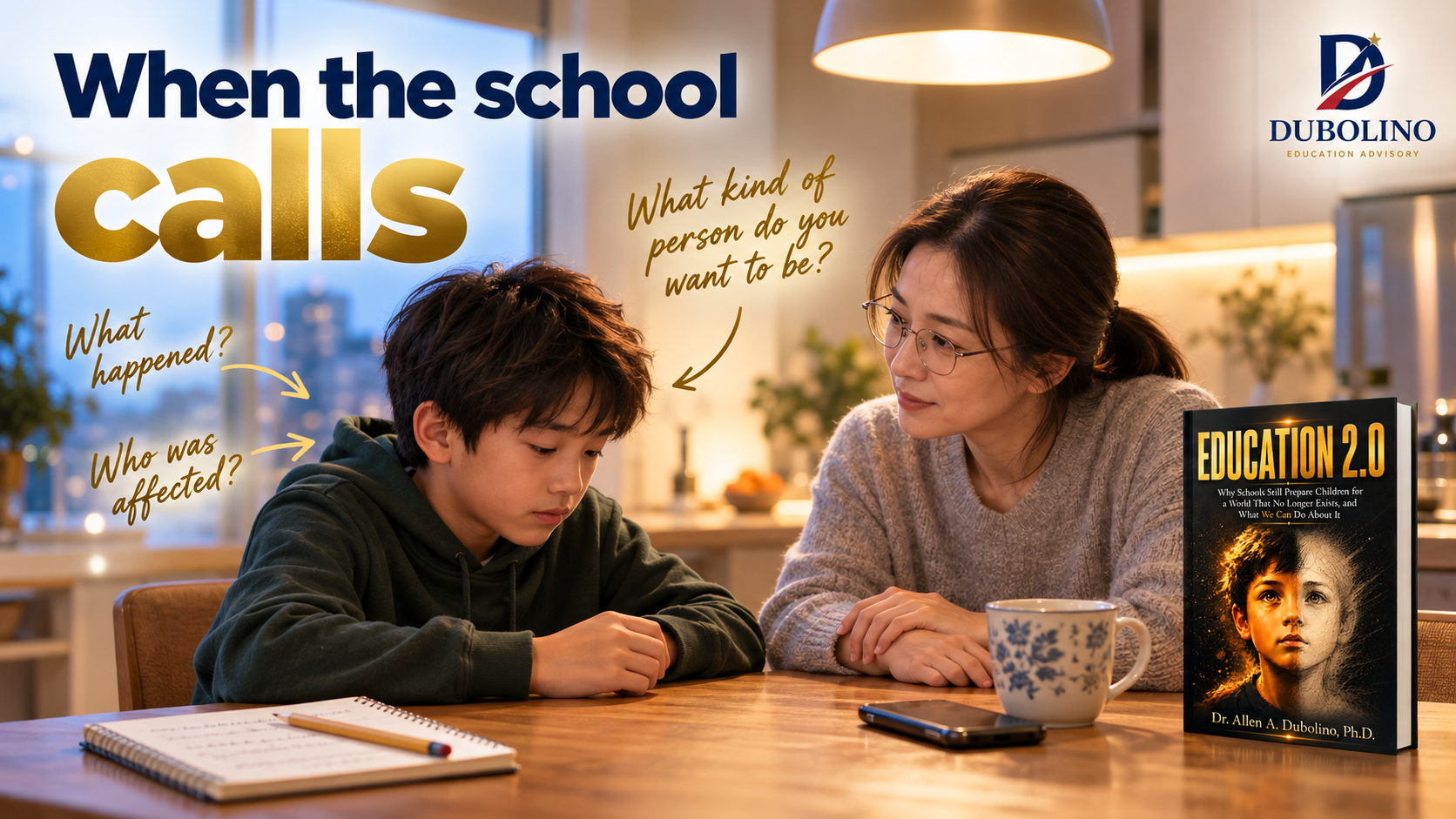
The Principal's Perspective
The phone rings, the screen shows the school's name, and your stomach drops before you have even answered. Every parent knows that moment. And sooner or later, the news really is what you feared: your child did something wrong. They pushed another child, copied someone's work, said something cruel, or broke something that mattered.
Children are human, and every one of them will get something badly wrong at some point. That part is not in your control. What happens next depends a great deal on what kind of school is on the other end of the line.
Two Schools, One Phone Call
In my chapter on discipline in Education 2.0, I describe two very different schools that can make that same call about the same incident.
Calling to report a punishment
Your child broke a rule. There is a consequence. The matter is closed. The tone is procedural, and your child is, in that conversation, a problem that has been processed.
Calling to begin a process with you
There is still a clear consequence, because actions have weight. But the consequence is not the point of the call. The point is that a caring adult is about to walk your child from what they did, toward understanding why it was wrong, repairing the harm, and becoming someone who would not do it again.
Same incident. Same mistake. Two very different outcomes for your child.
Consequence and Growth Belong Together
Conversations about discipline tend to split into two camps. One says schools have gone soft and need real consequences. The other says punishment does harm and children need understanding. Each side is half right.
The approach I argue for runs both on two parallel tracks. The first protects the community with a clear, proportionate consequence. The second develops the child through understanding, repair, and real change. Neither track ever runs alone. Consequence without growth is just punishment. Growth without consequence is a lesson with no weight behind it.
"Pure punishment can change what a child does for a little while. It almost never changes who a child is becoming."
A Conversation You Can Use at Home
At the center of the growth track is one structured conversation, and it works just as well at your kitchen table as in any school. It is not a lecture. When we lecture, we do the child's thinking for them, and they spend the whole time defending themselves. When we ask the right questions in the right order, the child reaches the understanding on their own, and that is the understanding they keep.
- What happened? Let them tell it without interruption.
- What were you thinking when it happened? Not to excuse it, but so they can name what drove them.
- Who was affected by what you did, and how? This is the question pure punishment always skips, and it is where empathy begins.
- What needs to happen to make this right?
- What kind of person do you want to be the next time you are in that same situation?
Notice the shape: from the event, inward to the self, outward to the people affected, and then forward to a plan. I think of an eleven-year-old boy who had shoved a younger classmate. He still faced a real consequence. But before that was decided, he sat with an adult and answered those questions out loud, and by the third one his voice cracked. He had not considered, until someone asked him directly, that the younger boy spent the rest of the morning too shaken to concentrate.
Why the Way Back Matters
In this kind of school, a child can always earn their way back. The consequence is real, but it is not permanent. Some parents worry that this makes it a loophole. It does the opposite. A child told they will forever be "the kid who did that" has no reason to try. A child who knows that repair leads somewhere has every reason to do the hard work of changing.
When you visit schools, ask what actually happens after a child does something wrong. Is there a conversation, or only a consequence? Is there a clear path back? The answers will tell you a great deal about how a school sees your child.
And whatever school your child attends, the conversation above is yours to use. Your child is not the worst thing they have ever done, and the hardest moments of childhood can become the ones that build the most character.
Education 2.0
Read the full chapter on discipline that builds character.
Education 2.0 lays out the six systems behind a school designed around your child, including how a school can turn a child's worst moment into real growth.
Dr. Allen A. Dubolino, Ph.D. is the founding Head of School at New American Chinese International School (Nonthaburi, Thailand) and Head of School at Four Leaves International School Tokyo. He has 22 years of international school leadership experience across Japan and Thailand and is the founder of Dubolino Education Advisory.
