
The Principal's Perspective
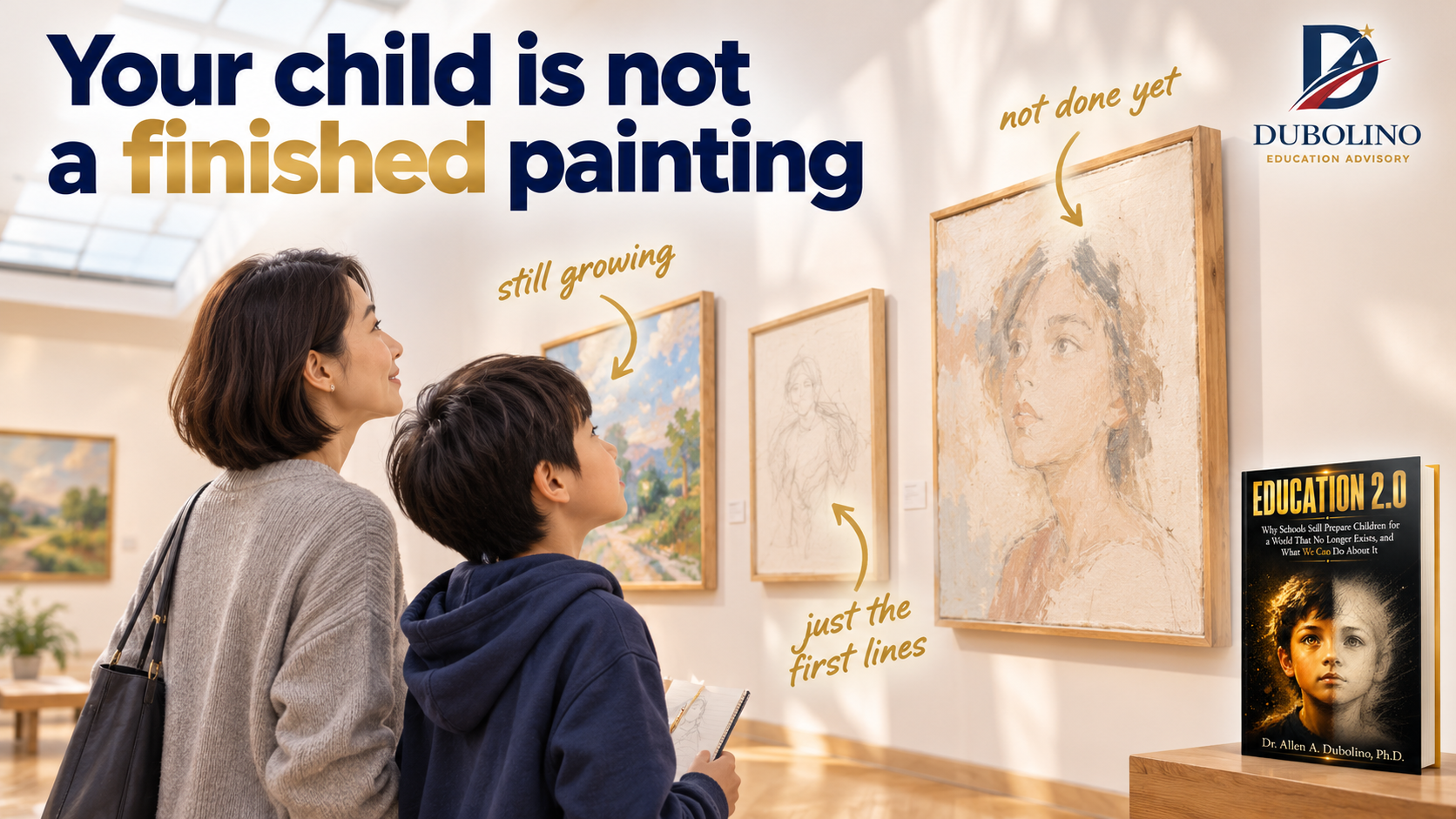
A few years ago I spent an afternoon in an art museum. I am no expert on art, and I usually spend more time reading the little cards on the wall than looking at the paintings. But one room stayed with me, and it had almost nothing to do with art.
The room was full of unfinished paintings. Some were only pencil outlines. Some had a face just beginning to appear on a blank canvas. Visitors walked past them without slowing down and crowded around the finished masterpieces in the next room. I stood there longer than I meant to, thinking about how often we do the same thing with children. We look at the first rough lines and believe we have seen the whole picture.
Arriving Too Early
We meet a six-year-old and quietly decide she is not a math person. We meet a ten-year-old and conclude he is not creative. We meet a fifteen-year-old who cannot sit still and talk about him as though his story is already written.
No gardener would walk into an orchard in early spring, point at a tree with no fruit yet, and declare that it will never amount to anything. The gardener knows the season is simply wrong. Nothing is failing about the tree. Children grow in seasons too.
The early bloomers
They read at four, shine at the school assembly, and collect praise early. Their growth is easy to see, so schools notice them first.
The late bloomers
They bloom quietly, long after most people have stopped watching. Their gifts are real, but they arrive on their own schedule, not the school's.
The root builders
Some children spend years building roots where no one can see the work happening. On paper they can look stalled. Underneath, something is growing.
The trouble is that most schools are impatient places. We test children every few months, then rank and label them, as if a person could fall behind schedule on becoming themselves. A caterpillar is not a failed butterfly. It is a butterfly that has not happened yet.
Watching Time Prove Us Wrong
I once knew a boy who could not spell. His tests came back covered in red ink, and many adults quietly decided he was not academic. Twenty years later, he owned three companies. Over the same years, I have met straight-A students who were afraid to make a single decision without permission.
One of the gifts of working in education for a long time is that you meet former students again, at twenty-five, at thirty, at thirty-five. The shy girl who never raised her hand is now leading the room. The class clown is a surgeon. The quiet one in the back leads a team of hundreds. Life has a way of ignoring our early predictions, including mine.
"Never confuse the chapter you are reading with the whole book. The child in front of you today is not a conclusion. They are an introduction."
Two Questions That Lead to Different Places
Schools tend to ask, what is this child? I would like them to ask, what might this child become? The two sound similar, but they lead to very different places. The first freezes a child in a single moment. The second keeps the future open. One is a verdict. The other is an invitation.
A teacher once apologized to me because one of her students was, in her words, just average. I asked her, average compared to whom? The tallest child? The earliest reader? The one with three tutors? There has never been an average child. There are only averages, made by comparing very different people and pretending the number says something about any one of them.
Giftedness is usually loud. It wins the prize and sits in the front row. Potential usually whispers. Sometimes it shows up as poor grades, endless questions, boredom, or stubbornness. A good school knows how to listen for it, because potential rarely introduces itself politely.
- How do you notice strengths that do not show up in test scores?
- When a child is labeled "behind," what happens next, and who decides?
- Do you measure progress against my child's own growth, or only against classmates?
- Can you tell me about a student who surprised you, and how the school supported them?
What Parents Can Do at Home
You do not need to ignore grades or pretend that struggles are not real. But you can keep one report card from becoming the whole story. Notice what your child keeps coming back to when no one is asking. Praise effort and curiosity, not only results. And when a teacher or a test seems to reach a final verdict, remember that you have seen far more of your child than any single assessment ever will.
The purpose of education is not to decide early which children have bright futures. It is to make sure no child's future is decided too early. Every child deserves at least one adult who looks at those first uncertain pencil lines and says, quietly, I think I know what this might become.
Education 2.0
Read the full chapter on the museum of unfinished masterpieces.
Education 2.0 explains why so many schools judge children too early, and how a school designed around each child can make room for every kind of bloomer.
Dr. Allen A. Dubolino, Ph.D. is the founding Head of School at New American Chinese International School (Nonthaburi, Thailand) and Head of School at Four Leaves International School Tokyo. He has 22 years of international school leadership experience across Japan and Thailand and is the founder of Dubolino Education Advisory.
