
Education 1.0, 1.5 or 2.0: What Kind of School Is Your Child In?
The Principal's Perspective
A mother once said something to Dr. Allen Dubolino after a long conversation about what isn't working in schools. She agreed with all of it. But when she tried to picture a different kind of school, she said, her mind went blank, or it pictured the same classroom with more iPads.
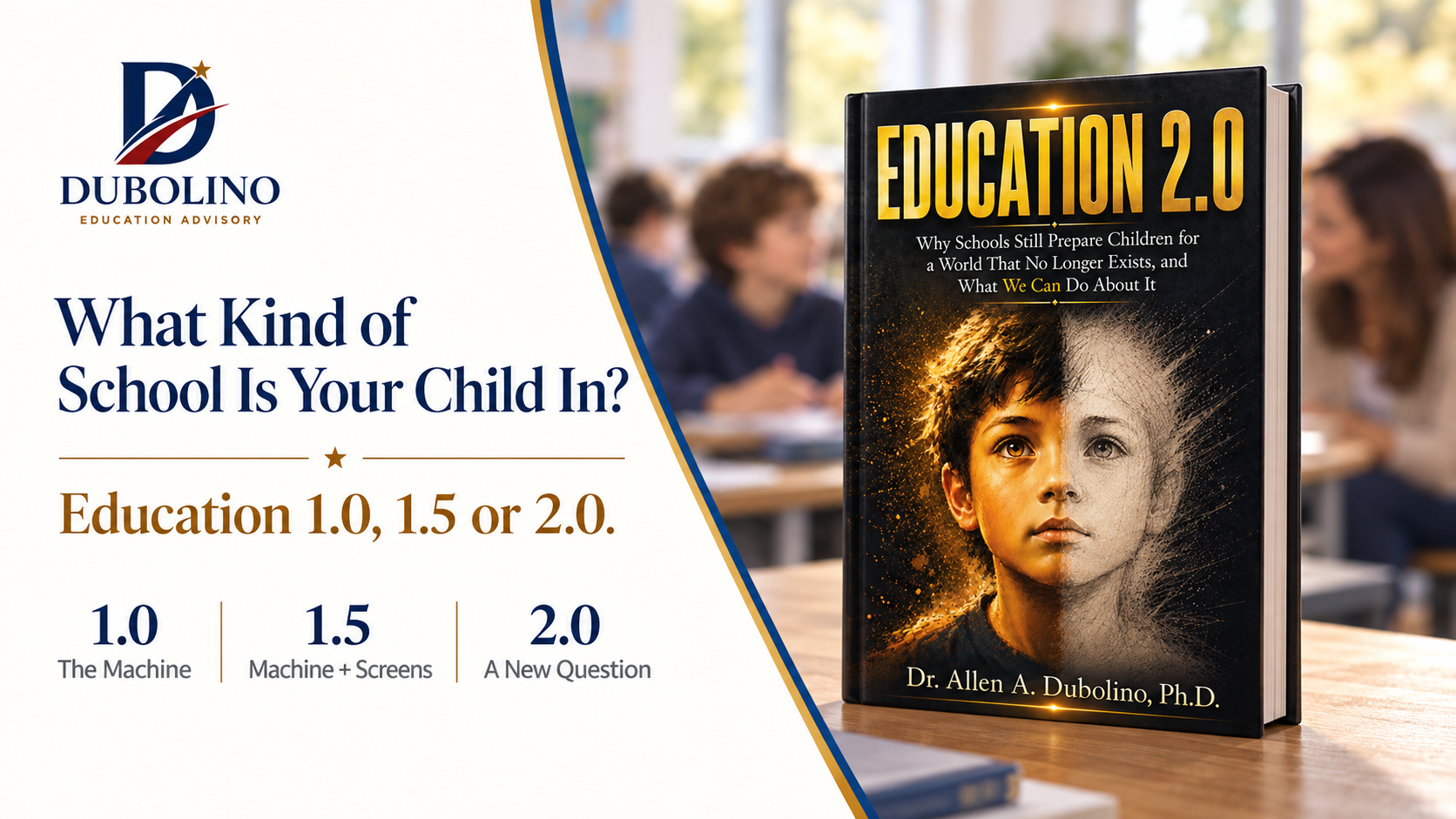
That moment became the starting point for one of the central ideas in his book, Education 2.0: Why Schools Still Prepare Children for a World That No Longer Exists, and What We Can Do About It. Most parents can sense when something is off. Very few have the words to describe what the alternative would look like. And it's hard to ask for something you can't name.
So the book offers a simple vocabulary. Three kinds of school, and a way to tell which one you're looking at.
Three Answers to One Question
The three schools aren't three levels of quality. They're three different answers to a question schools almost never ask out loud: what is a school actually for?
The Magnificent Machine
This is the model most children are in today. It was designed during the industrial revolution to produce a literate, numerate, punctual workforce at scale, and it borrowed the logic of the factory to do it. Children are grouped by age, moved along at a fixed pace, and measured against one standard at the end.
The book is clear that this model deserves respect. It worked. It brought education to entire nations and helped build the modern world. The problem is that the assumptions underneath it, that knowledge is scarce, that every child should learn the same things at the same speed, that school prepares you for one stable job, no longer hold.
The Machine With Screens
This is what happens when a 1.0 school feels pressure to modernize without actually changing. The chalkboard becomes an interactive whiteboard, the textbook becomes a tablet, the worksheet goes online.
But underneath, very little has moved. The teacher still delivers the same content to the whole room. Everyone still moves at one pace. Assessment is still an exam that produces a grade. The technology decorates the model rather than rethinking it.
A Different Question Entirely
Education 2.0 isn't 1.0 with better funding or 1.5 with better software. It starts somewhere else. Where 1.5 asks how technology can deliver the existing curriculum more efficiently, 2.0 goes back to the purpose itself and asks what a school should be for, if not to prepare a child for the world they'll actually inherit.
Why 1.5 Is the One to Watch For
Of the three, the book argues that 1.5 is the most important one for parents to recognize, precisely because it looks like progress. A school full of screens and innovation language can feel modern on a tour. The risk isn't that it fails. It's that it feels enough like change that everyone assumes the problem is being solved.
"A retrofit is not a reimagining."
That's not a reason to rule a school out. It's a reason to look past the equipment and ask how the school actually works.
- Does every child in the class move at the same pace, or can a child go faster or slower where they need to?
- When you remove the devices, how is a typical lesson actually taught?
- How are students assessed, and is a grade the main thing a parent receives?
- How does the school hire and develop its teachers?
- How does it handle discipline, and how does it talk to parents before a problem starts?
The answers won't sort a school neatly into one box. Most schools are a mix. But they'll tell you far more than a list of facilities ever could.
Education 2.0
The full framework, written for parents first.
Dr. Allen's book walks through what is changing in the world children will enter, why most schools haven't caught up, and what parents can do about it, including at their own kitchen table.
Dr. Allen A. Dubolino, Ph.D. is the founding Head of School at New American Chinese International School (Nonthaburi, Thailand) and Head of School at Four Leaves International School Tokyo. He has 22 years of international school leadership experience across Japan and Thailand and is the founder of Dubolino Education Advisory.
