
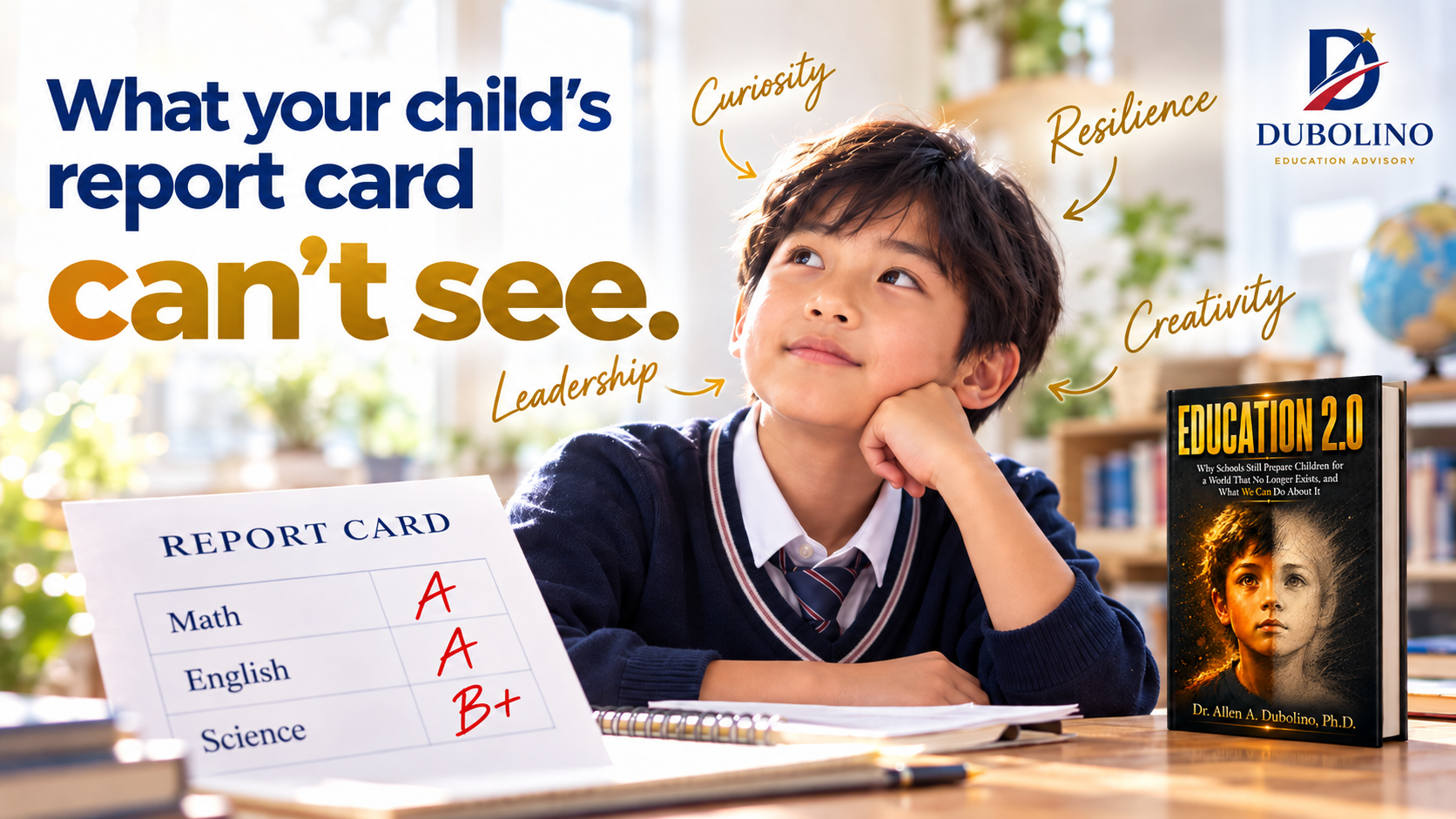
What Your Child's Report Card Can't See
The Principal's Perspective
Report cards arrive, and for a few days the house runs on them. One child's page is passed around with pride. Another child's page is respectable, unremarkable, quietly filed away. Everyone knows what those pages mean.
In his book Education 2.0, Dr. Allen Dubolino argues that we usually have it backwards, and he uses two students to show why. Both are composites, drawn from twenty-two years of watching versions of them in schools across more than one country.
The Child Who Glows on Paper
Top marks, year after year. Every assignment on time and immaculate. She knows precisely what each teacher wants and delivers it. By every number her school produces, she is a complete success, and her parents sleep well.
What the page cannot show is what she has never been asked to do. She is excellent at executing a task to specification, but ask her to generate something no one assigned, with no rubric to follow, and she freezes. She has spent twelve years coloring perfectly inside lines other people drew. And because her record was built partly by avoiding situations where failure was possible, the first real setback doesn't roll off her. She has no practice at the one skill her transcript never measured.
The Child Filed Under "Doing Okay"
Good marks, not dazzling. The middle of the pack. His parents love him but worry quietly, because they've been taught that a page which doesn't glow is a warning.
Meanwhile, he was doing things the report card had no column for. He ran a small business that made real money and taught him to talk to adults, to be told no, to lose money and work out why. When his family hit a hard season, he was the one who steadied the household. He thinks for himself, recovers from setbacks, and makes things that didn't exist before. None of it appears anywhere on his transcript.
The book's point isn't that one child is better than the other. It's that the report card sees the first clearly and is almost blind to the second. It gives its highest praise to the student who may be least prepared for what's coming, and files away as ordinary the one who may be most prepared of all.
What a Grade Actually Measures
Dr. Allen is careful here, and the distinction matters. Grades are not meaningless. A grade measures one real thing with reasonable reliability: roughly how well a child absorbed and reproduced a defined body of content under defined conditions. That's genuinely useful information.
The problem is what happens next. We take a child made of imagination, judgment, grit and character, capture one of those dimensions, print it on a page, and then let the page stand in for the child.
"The map gets mistaken for the territory."
And of all the dimensions it could have captured, the grade measures something close to the capacity that's falling fastest in value: retaining and reproducing content. We've built our whole system of judging children around measuring the thing the future needs least.
This Isn't a Story About Teachers
Worth saying plainly, because the book insists on it throughout. Teachers didn't invent this. They're handed a curriculum to deliver and a grading system to enforce, and they're judged on how faithfully they produce the numbers.
Many of them can see exactly what the grade misses. They can see the remarkable second child sitting in the third row. What they don't have is any official instrument for recording what they see. The problem isn't teachers measuring badly. It's a system that handed them one ruler and called it the only thing worth measuring.
What to Do With This as a Parent
None of this means ignoring the report card. It means holding it at its actual size, one useful reading of one dimension, rather than a verdict on your child.
- When did your child last attempt something with no instructions and no right answer?
- How do they respond when something genuinely doesn't work?
- What have they made, built or started that nobody assigned?
- Ask their teacher what they notice that the report card has no space for.
- If your child glows on paper, what are they quietly never being asked to develop?
For the child whose page doesn't glow, this is permission to look elsewhere for evidence. For the child whose page does, it's a reminder that praise can become its own kind of trap, reassuring everyone that the absence of what matters is nothing to worry about.
Education 2.0
Why the number on the page predicts less every year.
Dr. Allen's book looks at what is changing in the world children will enter, why the measures we rely on are losing their grip on it, and what parents can do about it, starting at their own kitchen table.
Dr. Allen A. Dubolino, Ph.D. is the founding Head of School at New American Chinese International School (Nonthaburi, Thailand) and Head of School at Four Leaves International School Tokyo. He has 22 years of international school leadership experience across Japan and Thailand and is the founder of Dubolino Education Advisory.
