
Why Hard Work Feels Different to Your Child Now
The Principal's Perspective
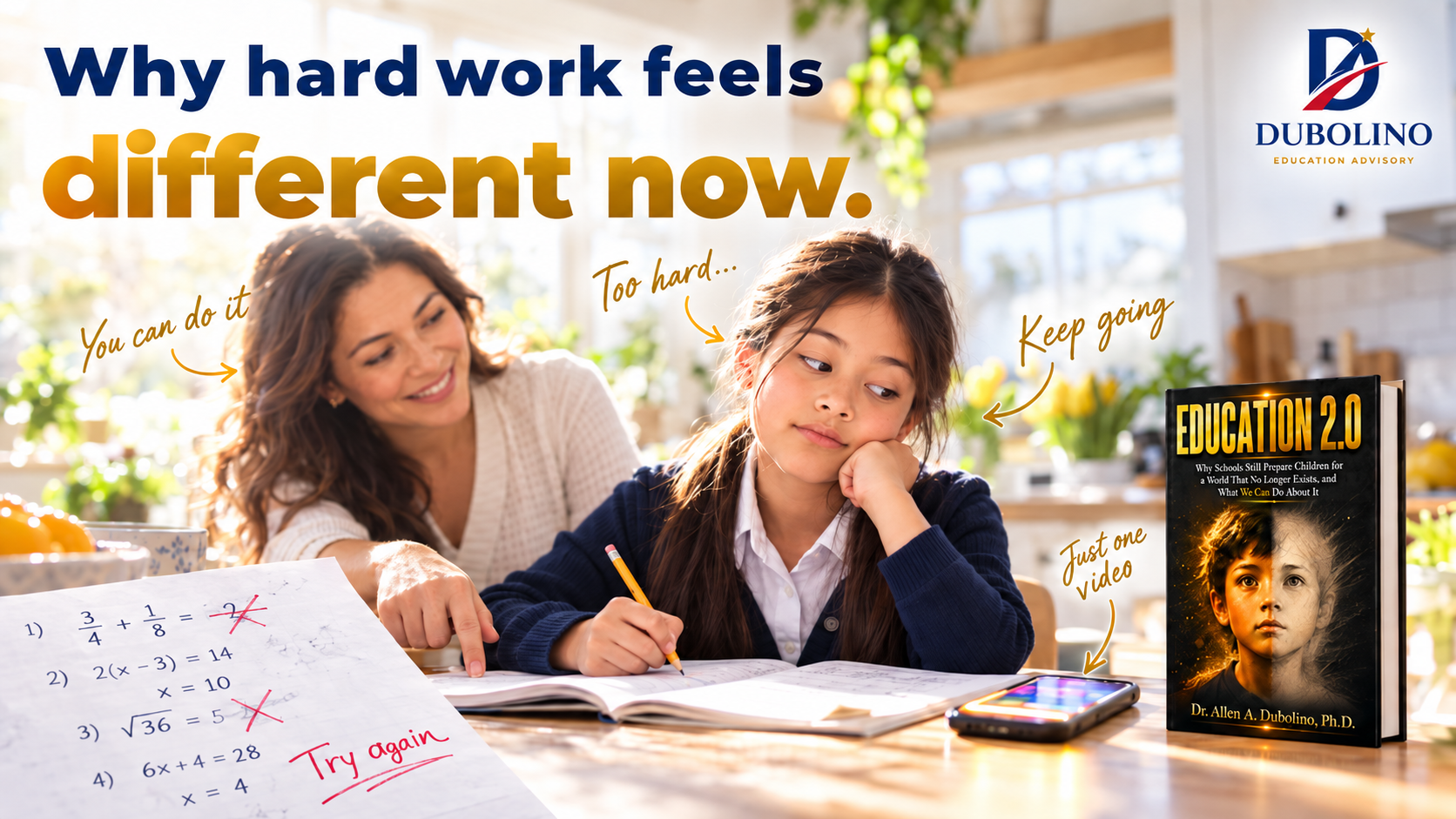
Most parents have seen it. Homework comes out, the first problem is harder than expected, and within a minute your child is up, distracted, or insisting they "just don't get it." It can look like laziness. It usually isn't.
In Education 2.0, Dr. Allen Dubolino argues that something has changed in how children experience difficulty, and that it has less to do with character than with the environment they grew up in. It's one of the most useful ideas in the book for parents, because it changes how you read what's happening at the kitchen table.
A world built to remove the hard part
For about twenty years, most of us have spent our days around apps and feeds designed to hold attention. They work by removing friction. If something is slow or boring, there is always something faster one swipe away.
Children growing up in that environment learn a simple lesson, repeated thousands of times: when something gets uncomfortable, you can leave.
The problem is that learning depends on the opposite. Every real skill has a stretch where it is hard, where you don't understand yet and want to stop. That stretch isn't a sign that something has gone wrong. It's where the learning actually happens.
The classroom asks children to do the one thing the rest of their day has trained them not to do: stay in the hard part.
Why feedback can feel like criticism
The book points to a second change. Online, most of us see content that agrees with us. Over time, being told "this isn't right yet" can start to feel less like help and more like an attack.
For a child, that can show up as tears over a corrected essay, or frustration when a coach asks them to try again. School runs on feedback, so when correction feels personal, ordinary teaching becomes harder for everyone. That isn't the teacher's fault or the child's. It's a skill that needs to be rebuilt.
It applies to parents too
This is the part of the chapter many readers find uncomfortable. The same systems shaped adults, including how we take in news about schools.
Posts about schools failing children spread quickly because worry holds attention. A parent who sees enough of them can start reading an ordinary email from a teacher in the worst possible light. The book's point isn't that parents should stop asking questions. It's that some of our concerns are earned and some were handed to us by a feed, and it helps to know which is which.
What this means for choosing a school
Dr. Dubolino's argument is that many schools still assume children arrive with the patience and resilience of a generation ago. When those children struggle, the school treats it as a discipline or motivation issue.
A school designed for the children actually sitting in its classrooms looks different. It teaches tolerance for difficulty on purpose instead of assuming it. It gives feedback in a way students can hear. And it builds trust with families early, before a problem arises.
These things are hard to see on a tour, but you can ask about them.
- What do you do when a student gives up quickly on difficult work?
- How do teachers give feedback, and how do students learn to use it?
- How do you handle phones and screens during the school day?
- How do you build a relationship with parents before something goes wrong?
What you can do at home
None of this requires dramatic changes. Small things help. Let your child stay with a hard problem a little longer before stepping in. Treat boredom as normal rather than something to fix right away. When you give feedback, focus on the work, not the child.
And notice your own habits. Children learn more from what they see us do with our phones than from what we tell them.
The encouraging part of the chapter is that this is a design problem, not a character problem. Patience with difficulty can be taught again, at home and at school, once we recognize it has to be.
Dubolino Education Advisory
Looking for a school that understands today's children?
We help families in Japan and Thailand find schools that fit the child they actually have. Get in touch if you'd like help thinking through your options.
Dr. Allen A. Dubolino, Ph.D., is Head of School at Four Leaves International School Tokyo and the founding Head of New American Chinese International School in Thailand. He has led international schools in Japan and Thailand for 22 years and is the founder of Dubolino Education Advisory. His book, Education 2.0: Why Schools Still Prepare Children for a World That No Longer Exists, and What We Can Do About It, is available now.
