
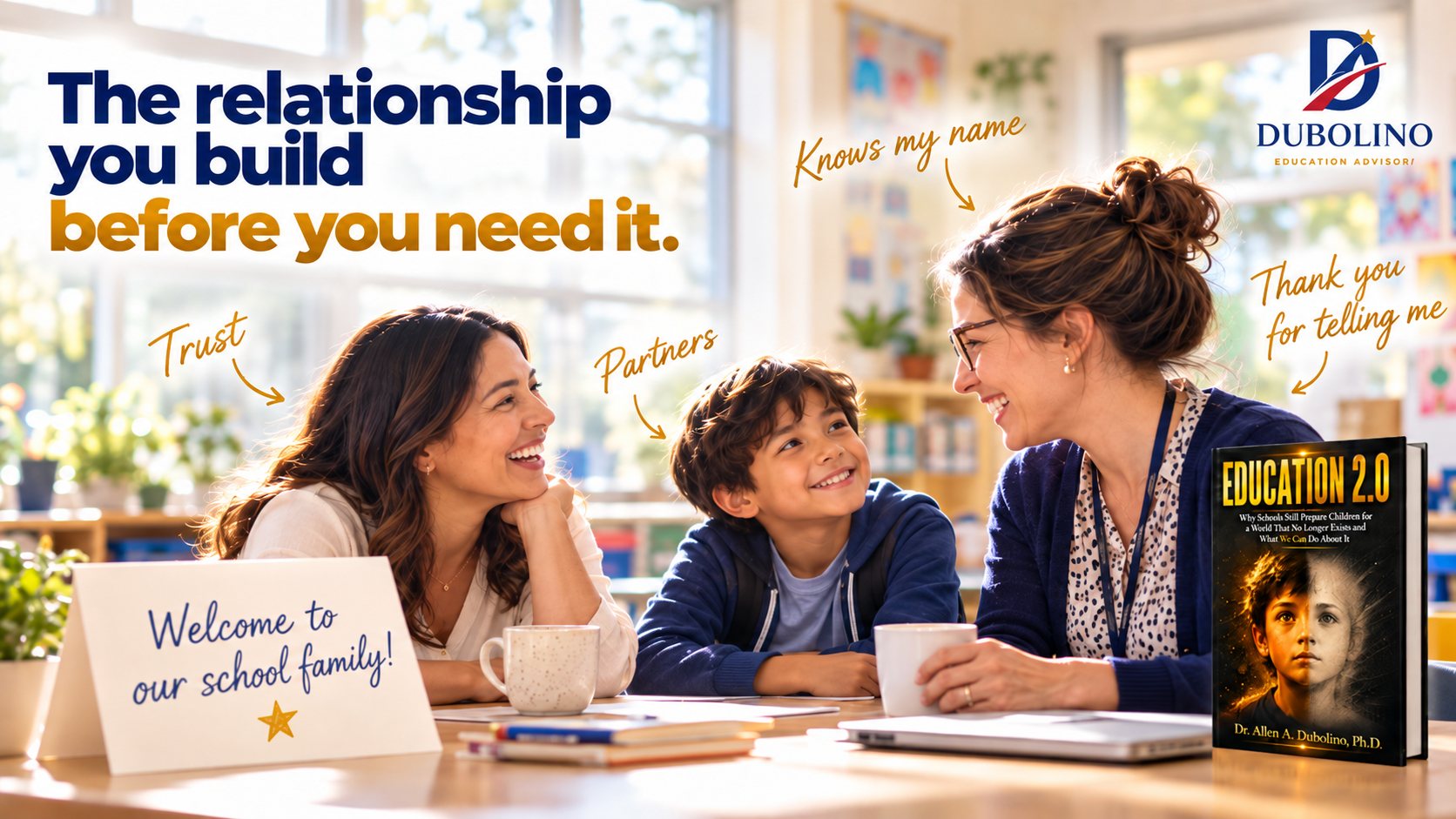
The School Relationship You Build Before You Need It
The Principal's Perspective
Think about the last time your child's school contacted you personally. Not a newsletter or a calendar reminder, but a real person reaching out to you directly.
For many families, the honest answer is: when something went wrong. A grade dropped, an incident happened, a form was late. Everything else arrives as a broadcast. So when a teacher's name finally appears on your phone, your first reaction is worry.
In Education 2.0, Dr. Allen Dubolino argues that this pattern quietly shapes the whole relationship between home and school, and that good schools fix it on purpose, long before anything goes wrong.
Deposits and withdrawals
The book uses a simple comparison. Every contact between a school and a family is either a deposit or a withdrawal.
A teacher mentioning something good your child did, a school leader who knows your name, a friendly conversation at a school event: those are deposits. A call about a problem or a hard conversation about a struggle: those are withdrawals.
A withdrawal only works if there is already something in the account. If the first real conversation a parent has with a teacher is about a problem, there is nothing to support it.
Same phone call, two different outcomes
The book describes two parents receiving the same call about the same minor incident.
An empty account
All year, this parent has received newsletters and attended one short conference. The call comes from someone they barely know. They feel defensive, assume the school is being unfair, and a small issue turns into weeks of emails and meetings.
A full account
This parent has met the teacher at a few school evenings, shared a table at a family event, and seen the teacher laughing with their child on sports day. When the call comes, they listen, ask questions, and say: "Thank you for telling me. What can we do together?"
Same child, same incident, same teacher. The only difference is the relationship that existed before the call.
You can't build a partnership in the middle of a crisis. The trust has to already be there.
Why the first month matters
According to the book, the first thirty days of a family's time at a school often decide whether this relationship forms at all. Schools that take it seriously make the early contact personal: a call from a school leader before the first day, a short coffee with the teacher in the first weeks just to ask how things are going, and a check-in around the one-month mark.
None of this is expensive. It just has to be deliberate.
Clear rules for messages
The book also raises something most schools haven't thought through: how parents and teachers communicate by phone and app. Without clear rules, a message sent late at night can feel urgent, and a serious concern can get lost in a casual chat thread.
Schools that handle this well tell families which channel is for what. Apps for schedules and notices. Email for things that need a written answer. Real concerns go to a phone call or a face-to-face meeting. And every message gets acknowledged within a day, even if the full answer takes longer.
What to ask a school
This is one of the easier things to check before you enroll. A school's answers will tell you whether it sees parents as partners or as people to keep informed.
- How do you welcome new families in the first month?
- When would I hear from my child's teacher, apart from when there's a problem?
- Do you hold events where parents can get to know teachers in person?
- Which channels should I use for what, and how quickly do teachers usually reply?
- How do you handle a difficult conversation with a family?
Why it matters for your child
Children notice when the adults around them are on the same side. When home and school are connected, the same values are reinforced in both places, and the teacher understands what parents see at home. That consistency helps children feel secure.
The book puts it simply: it's the difference between a school that has parents and a school that has partners. That partnership is built in ordinary moments, well before it's needed.
Dubolino Education Advisory
Looking for a school that treats you as a partner?
We help families in Japan and Thailand find schools that fit their children and their families. Get in touch if you'd like help thinking through your options.
Dr. Allen A. Dubolino, Ph.D., is Head of School at Four Leaves International School Tokyo and the founding Head of New American Chinese International School in Thailand. He has led international schools in Japan and Thailand for 22 years and is the founder of Dubolino Education Advisory. His book, Education 2.0: Why Schools Still Prepare Children for a World That No Longer Exists, and What We Can Do About It, is available now.
